
Episode 100
A pledge I made to myself.
My northern star.
The last episode of The Ten Crutches Podcast.
ON VACATION until Aug 15
The episodes will keep dropping every Monday at noon, but this site will not be updated with show notes, etc until mid-August. Thanks for visiting and have a great summer!
In the queue:
Episode 45: The Universe As A Giant Recycling Center (July 20)
Episode 46: The Trap And The Tool Are The Same Thing (July 27)
Episode 47: Worshiping Idols (August 3)
Episode 48: The Religion That Does Not Exist (August 10)
Episode 44: Let Moments Die. Let Moments Be Born.
Released on July 13, 2026
If you are really dedicated to becoming more and more present in your life, one thing becomes very clear: birth and death happen all the time. How can we be more gracious and accepting of this truth?
Episode 44
Show Notes for E44
This episode was, in part,
inspired by Roshi Kurt Kankan Spellmeyer and his dharma talk about Case 32 from the Blue Cliff Records.
Unfortunately, I have no recollection of what exactly what he said that inspired me. I find this Roshi’s talks a bit long, slow and meandering, even rambling at times. Then again, when the talk is over, somehow he has expressed something very true and helpful to understanding the koan under discussion.
The quote
“The past isn’t dead. It isn’t even the past” can be found in William Faulkner’s novel Requiem for a Nun.
Episode 43: A Prayer For Poop
Released on July 6, 2026
This episode is potentially NSFW, as I also refer to poop with a common-enough word your co-workers may not want to hear.
We easily accept saying a prayer and/or expressing our gratitude when we eat. But putting food into one end of our tube is only the beginning.
We all know what comes out the other end. Is it pleasant to talk about? No. Is it important to think about? Yes. What could be more important than for people to deal, literally, with their poop?
It’s essential we do not turn away from reality, even if it is unpleasant. We can all offer a prayer for our poop.
Episode 43
Show Notes for E43
This episode was inspired
while reading Chapter 9 “There Is No Away,” in the book Hospicing Modernity: Facing Humanity’s Wrongs and the Implications for Social Activism by Vanessa Machado de Oliveira.
Her book is simply amazing: dense and powerful. If you let the contents of this book work on you, I have no doubt it will change your definition of what the world is and who you are in it.
A quote from this book’s description:
“This book is not easy: it contains no quick-fix plan for a better, brighter tomorrow, and gives no ready-made answers. Instead, Vanessa Machado de Oliveira presents us with a challenge: to grow up, step up, and show up for ourselves, our communities, and the living Earth, and to interrupt the modern behavior patterns that are killing the planet we’re part of.”
I can also recommend
The Humanure Handbook: Shit in a Nutshell, by Joseph C Jenkins. This is for those who want to get practical about the sacred material leaving our bodies.
A quote from this book’s description:
“Not only does the book address what to do with human turds, but it is also a priceless manual for anyone involved in composting or gardening, or looking for basic survival skills. There is no other book like this in print!”
Episode 42: Your Existence Is A Series Of Events, Not A Story
Released on June 29, 2026
How is our existence different from our “life?”
So many people are disdainful and/or dismissive of their own existence, as if the only reason they exist is to “have a life.”
Why do so many people focus only on making “a success” of their life? Why do so many ignore the miracle of their simple existence (which is beyond success & failure)?
Episode 42
Show Notes for E42
This episode, of course,
is the flip side of the previous episode. Many of the ideas I present here were greatly inspired by chapter 4 (“The Existentialism of Zen”) of Zen and the Psychology of Transformation, by Hubert Benoit. Much gratitude for this fine book.
Near the end
of the episode, I was talking about how it may seem like existence either favors us or not, how existence seems to be moving to support us or not. I believe the truth to be much closer when we say it is we ourselves who are moving. Here is a quote from Eihei Dogen and the Genjokoan:
“When you ride in a boat and watch the shore, you might assume that the shore is moving. But when you keep your eyes closely on the boat, you can see that the boat moves. Similarly, if you examine myriad things with a confused body and mind you might suppose that your mind and essence are permanent. When you practice intimately and return to where you are, it will be clear that nothing at all has unchanging self.”
Episode 41: Your Life Is A Story, Not A Series Of Events
Released on June 22, 2026
This episode is an affirmation of our amazing story-telling abilities. I love a good story! With regards to the story of our own life, we are both the storyteller and the audience. Hats off to Atul Gawande for the quote from Being Mortal that inspired this episode. (You can scroll down further and see it in the show notes.)
We are all individuals living a life. We are all “somebody.” Even if the story we tell ourselves about our life is constructed, it’s a very important construction. To help us become even better storytellers, I include a few limitations we face while creating stories about our lives.
The story of each life needs to be told well and not taken lightly.
Episode 41
Show Notes for E41
Much of the initial inspiration
for this episode came from the following quote by Atul Gawande. It can be found in his book Being Mortal.
“In the end, people don’t view their life as merely the average of all its moments—which, after all, is mostly nothing much plus some sleep. For human beings, life is meaningful because it is a story. A story has a sense of a whole, and its arc is determined by the significant moments, the ones where something happens. Measurements of people’s minute-by-minute levels of pleasure and pain miss this fundamental aspect of human existence. A seemingly happy life maybe empty. A seemingly difficult life may be devoted to a great cause. We have purposes larger than ourselves.”
Write your own origin story?
I first heard this idea in the Akimbo podcast by Seth Godin. You can listen to his episode about “Origin Stories” here. One thing Godin points out is how many times an origin story is told both by comic book heroes and corporations to identify their super power.
The essentials of an origin story are this:
- Something happened
- A choice was made
One easy example is Spiderman. It’s one thing to be bitten by a spider and discover you have suddenly developed some crazy abilities. When Peter Parker first starts exploring his new state, he has no mission, no vision of who he is as someone with these powers. But one day, he fails to use his powers to stop a criminal from escaping the police. He could have, but he didn’t. It was a moment of indulgent laziness.
Turns out that criminal ends up killing his uncle. That’s a very strong “something happened.” It led directly to Peter deciding to use his power to fight crime. That’s a very strong decision.
And that’s what an origin story is.
What is yours? I encourage you to try it out.
What happened in your life? What choices did you make? What is the story that resulted in you being who you are today? When I tried it, I found I could choose from at least 3 really significant events, and three choices that I made, all important in making me who I am.
If you want a good example of an individual (who is not a superhero) developing an origin story, check out the podcast I linked to before. Seth Godin shares his origin story: it starts with a teen crossing Lake Erie, on a trip his father arranged for him.
Episode 40: Fall In Love With Heisenberg’s Uncertainty Principle
Released on June 15, 2026
Werner Heisenberg was deeply involved with the beginning of quantum mechanics. He focused on what he could observe about electrons, rather than use old pictures of electrons “orbiting” the nucleus of an atom. When he was only 23, he developed matrix mechanics.
What is Heisenberg’s Uncertainly Principle? It essentially states there are pairs of properties, (for example position and momentum,) that cannot both be known with certainty at the same time. Knowing more about one property means you know less about the other.
At one time, people thought, “Hey! If we knew the position and momentum of every particle in the universe, we could make accurate predictions about exactly how the universe will unfold. It would be just like predicting where a billiard ball would go.” You can see this very human desire to predict take on new force as AI develops.
I don’t think the Uncertainty Principle has really sunk into our culture at large. Most people don’t feel comfortable recognizing the depth of uncertainty in life. But uncertainty is a property of reality itself.
Since uncertainty is what we are made of, let’s fall in love with it.
Episode 40
Show Notes for E40
The Uncertainty Principle
was published in 1927. The principle describes how specific pairs of physical properties cannot both be known at the same time. The formal equation looks like this:
Δx · Δp ≥ ℏ/2
If you are a nerd like me who wants to at least understand what the symbols mean, check this out.
Remember: the uncertainty being described here is a fundamental feature of the universe. It’s not about measurement disturbance (meaning it’s not that a measuring instrument “bumps into” the particle). It’s that all particles have a wave nature. Or maybe it’s that all waves also have a particle nature. Nobody is certain!
Correction:
In this episode, I mentioned other pairs that share the uncertainty with the Position/Momentum pair. One was Energy/Time.
The other I mentioned was Angular Momentum/Position. That was the mistake.
Angular Momentum is a pair with Angle. I guess I thought “angle” is a kind of “position,” and maybe that’s how I got mixed up? Doesn’t matter. The correct pair is Angular Momentum/Angle.
The meaning of this third uncertainty is that the more you learn toward which angle a particle-wave is pointing, the less you know how fast it’s spinning. And vice versa.
Thanks for coming to the website and thanks for listening.
Episode 39: There Is Nothing You Can Do, So Make Every Effort
Released on June 8, 2026
A riff based on the following:
1) My subjectivity appears separated from the unity of the universe. This can feel like a prison or a trap or comfortable cocoon or anything in between. Any effort I make to “merge with the universe” is simply more “me” being “me.” No idea or plan can work, since ideas and plans only reinforce the separated subjectivity I wish to leave. One simple fact to accept: there is nothing I can do.
2) I can and must make every effort to escape the trap of being separate.
Either thought, on it’s own, leads to feeling helpless and hopeless. You either give up or bang your head against a wall. This episode attempts to place the two statements together in a larger picture.
Episode 39
Show Notes for E39
Here is a quote:
found on page 72 (of 119) in a PDF of Alan Watts’ On the Taboo Against Knowing Who You Are. The whole chapter was a great source of ideas for this episode.
“As soon as one sees that separate things are fictitious, it becomes obvious that nonexistent things cannot “perform” actions. The difficulty is that most languages are arranged so that actions (verbs) have to be set in motion by things (nouns), and we forget that rules of grammar are not necessarily rules, or patterns, of nature. This, which is nothing more than a convention of grammar, is also responsible for (or, better, “goeswith”) absurd puzzles as to how spirit governs matter, or mind moves body. How can a noun, which is by definition not action, lead to action?
Scientists would be less embarrassed if they used a language, on the model of Amerindian Nootka, consisting of verbs and adverbs, and leaving off nouns and adjectives. If we can speak of a house as housing, a mat as matting, or of a couch as seating, why can’t we think of people as “peopling,” of brains as “braining,” or of an ant as an “anting?” Thus in the Nootka language a church is “housing religiously,” a shop is “housing tradingly,” and a home is “housing homely.” Yet we are habituated to ask, “Who or what is housing? Who peoples? What is it that ants?” Yet isn’t it obvious that when we say, “The lightning flashed,” the flashing is the same as the lightning, and that it would be enough to say, “There was lightning”? Everything labeled with a noun is demonstrably a process or action, but language is full of spooks.”
Episode 38: Support The Copernican Revolution!
Released on June 1, 2026
The Copernican Revolution uprooted the idea that a non-moving Earth was at the center of the universe. Instead, it placed a non-moving Sun at the center of the universe. But even our galaxy isn’t at the center of anything. It’s zipping along thru space exactly like countless other galaxies.
And like humans who considered the Earth to be at the center, most of us think and feel and act as if we are at the center.
At the center of what? Of life itself? Of what’s important?
We can each undergo a Copernican Revolution of the self. We can realize it does not make sense to think of ourselves at the center of anything, except our current frame of reference.
The Copernican Revolution must continue! Support the Copernican Revolution!
Episode 38
Show Notes for E38
The Universal Pictures logo
shown in front of our little, tiny planet at the edge of one of billions of galaxies. Why does it seem so natural? Why doesn’t this make people burst out laughing?

Plants having consciousness?
This was completely common knowledge to every indigenous tribe, like, ever. What happened to us so-called civilized people that things like this are happening?
Better late than never, I guess. It’s just SO weird to me it seems such a surprise to scientists that plants may have consciousness. You mean, you never noticed how intelligent plants are?
Itzhak Bentov wrote a book
called Stalking the Wild Pendulum: On the Mechanics of Consciousness. It is well worth a read, even if just for the instructions on how you can stop the movement of the second hand of a clock (without touching anything, of course.)
I had the great good fortune of hearing Bentov speak at Tufts University in 1978, just a year before he died. He was talking one evening to a small group of nerds fascinated by consciousness. He began by standing in front of a classroom with about thirty of us in attendance, dropping a bag of cough drops on the desk. He explained how addicted he was to cough drops and pretty much continuously kept popping them in his mouth all evening.
After about an hour of his wildly entertaining (to me) and completely esoteric ramblings, we took a short break. When we returned to hear the second half of the talk, about half the audience had left. This delighted Bentov. He rubbed his palms together enthusiastically and said, “Excellent! Now we can get to the good stuff.”
Episode 37: Giving Up The News
Released on May 25, 2026
Many people keep up with the news automatically. It’s just an accepted part of our culture that you will know “what’s going on.” And, of course, there are good reasons to be aware of important current events.
But there is also a harm involved in “keeping up with the news” mindlessly. It’s just not good for a human nervous system to take on that much stress. I think it is well worth considering getting off the news entirely, or at least taking regular breaks.
Assess what you need (and what you don’t). Then act accordingly.
Episode 37
Show Notes for E37
I sure wish
I could have found a picture of that old sculpture I talk about in the video, the one with the two bicycle wheels for eyes. It was great! I hope I can show it to you someday.
Some of the ideas
in this episode come directly from Episode 28, “Limits of Language,” from the Alan Watts podcast Being in the Way. I find most of what Alan Watts has to say well worth a listen.
Here is the website
with news from 40 years ago. You can get you some sense of what seemed urgent at that point, what seemed timely, and what is now mostly forgotten.
Episode 36: We Can’t Help Ourselves = We Must Help Ourselves
Released on May 18, 2026
A riff on, well, just what the title says.
We do not seem to be able to stop ourselves, as a whole species, from ignoring strong evidence of being needlessly destructive. We can’t even stop long enough to genuinely evaluate risk.
We are helpless in the face of our greed and aggression. We have not developed any way to work together, as a species, with all of us caring for all of us.
But somehow we must.
Episode 36
Show Notes for E36
If you didn’t read this in high school,
it’s worth checking out: The Lord of the Flies, by William Golding.
The chess-playing machine
I mentioned in the episode was called AlphaZero. Read more about it here.
AlphaGo (the precursor to AlphaZero) has a wonderful documentary about it here.
When watching the documentary, in addition to learning a lot about the project, you will see how the people involved simply plunge ahead with their creation, despite many active doubts. They are aware of potential catastrophes, but completely unable to stop (or even significantly pause!) to try to compensate for possible disastrous consequences. It’s as if a race were on and they simply must get there first.
Episode 35: The Infinite Value Of Boredom
Released on May 11, 2026
What is boredom? Why would anyone wish to avoid it? If dopamine hits keep us scrolling for hours, then what? If the crunchy chips taste so good we can’t stop eating them, what do we do for nutrition?
We need boredom the way we need air, healthy food, movement and good sleep. We need downtime in our lives to form stories and memories and simply think about things. Boredom opens doors we forget are right in front of us.
Fair warning! You may find this episode boring. I talk very slowly at times; I also leave several long pauses. I strongly suggest you listen to this episode as it was recorded and not speed it up. You can genuinely use the episode to explore boredom. (Or help you go to sleep.)
Episode 35
SHOW NOTES FOR E35
For your viewing pleasure:
Here is the Painting I mentioned called “Scholar Reclining and Watching Rising Clouds.”
I find it fascinating that, in another culture at another time, it was quite normal for a scholar to simply lay down and watch the clouds. And worth celebrating in a painting!
In part, this episode
was inspired by episode (#232) of Stephen West’s podcast Philosophize This! It was about Byung Chul Han and his book The Crisis of Narration.
Here is a quote from the Philosophize This! transcript of episode 232:
“And Han, far from being someone that wants to offer a prescription to people to solve it, he’s not hocking a seminar that people need to come to…no, he just thinks we don’t need to be living…in a constant state of disenchantment about the world we live in.
There are ways to create distance in your life…from these things that are hostile to you having a narrative connection with things. And again, while he’d never say he knows how to fix this…maybe one thing near the top of his list that he’d recommend is to make space in your life… for a little more boredom.”
West goes on to say:
“Because without that space…without being able to reflect on what something truly means, or to connect a moment to something larger than just right now: stories will never be able to form; memories can’t form; you never slow down long enough…to know even where you are. A little bit of boredom…is an invitation to explore who you truly are.”
Episode 34: Attention! Attention! Attention!
Released on May 4, 2026
An exploration of where our attention usually goes and what might help it land more deeply in the present moment.
Episode 34
SHOW NOTES FOR E34
Much of the material
in the episode was inspired by ideas presented in Chapter 19 (“The Immediate Presence of Satori”) of the book Zen and the Psychology of Transformation, by Hubert Benoit.
Episode 33: Intuition PART 2 – Creating A Ritual To Help Cultivate Intuition
Released on April 27, 2026
Podcast Blurb
In episodes 21 and 22, I spoke about rituals. I promised back then to talk about intuition. So here we are.
What is intuition?
What will help you cultivate your intuition?
Part 1 (of this two-part series) gives my answer to these two questions.
Can I build a ritual to help deepen my intuition?
Yes! Part 2 has specific instructions for creating a ritual that will help cultivate intuition. My intention is to help someone who has never created a ritual before to do so. (In other words, if you have created ritual before, you may find these instructions overly simplistic. Thankfully, you have the power of “fast forward” at your fingertips!)
And here we go!
Time Stamps for Instructions:
# 1: Pick time and place (6:59)
# 2: How long will the ritual be? (8:55)
# 3: Write down the times of the intro, the middle and the exit of the ritual (11:13)
# 4: Plan the Intro (15:25)
4A: Four suggestions for the intro (21:23)
# 5: Plan the middle of the ritual (29:21)
# 6: Plan for the exit (37:38)
6A: Four suggestions for the exit (38:40)
Episode 33
SHOW NOTES FOR E33
I strongly recommend
listening to Episodes 21 and 22, which are both about ritual. Ritual and intuition are closely related. Even if you are not planning on being further involved with ritual, you may find the description of “liminal space” interesting enough to be worthwhile.
While you are here
in the Archive, I also encourage you to read the show notes for Episodes 21 and 22. They include some links that may help broaden your perspective about ritual.
For anyone with mobility issues,
my apologies for ignoring your situation during the instructions. I said you can do this ritual “either lying down or standing up.” I imagine you already correct for this absence of consideration in many different parts of your life. I’m sorry you had to do it yet again with me.
Episode 32: Intuition PART 1 – What Is Intuition?
Released on April 20, 2026
Podcast Blurb
In episodes 21 and 22, I spoke about rituals. I promised back then to talk about intuition. So here we are.
What is intuition?
What will help you cultivate your intuition?
Part 1 (of this two-part series) gives my answer to these two questions.
Can I build a ritual to help deepen my intuition?
Yes! Part 2 has specific instructions for creating a ritual that will help cultivate intuition. My intention is to help someone who has never created a ritual before to do so. (In other words, if you have created ritual before, you may find these instructions overly simplistic. Thankfully, you have the power of “fast forward” at your fingertips!)
And here we go!
Episode 32
SHOW NOTES FOR E32
Some aspects of this episode
developed from Rupert Sheldrake’s book The Science Delusion. Sheldrake chose his title in response to Richard Dawkins’ book The God Delusion.
Sheldrake isn’t criticizing science; he is critical of scientists, most of whom are human and, in the current fashion, materialists. (Materialists are those who believe matter is the only thing that exists; all phenomena can be explained in terms of materials. This is why a materialist will think, for example, that human consciousness can only emerge from the brain and can only be explained by neurons and physical structures in the brain.)
Sheldrake sees many scientists believing in certain “facts” just as stubbornly as Dawkins sees folks holding on to beliefs about God. To Sheldrake, blind scientific belief is no different from blind religious belief.
In The Science Delusion, Sheldrake lays out ten “truths” that science currently considers as “rock-solid” truth. He then points out the many problems and contradictions that accompany these “truths.” Rather than attacking science itself, he proposes, over and over, to use science, to use objective inquiry and repeatable experiments in order to discover what might be closer to true. He encourages us to see how we might shift our views in order to explain phenomena materialists cannot adequately explain.
Gut sense
This article has the usual limitations of the materialistic point of view. It’s trying to get everything to make sense in terms of physical structures and entities that can be identified and named clearly and distinctly and then measured and tracked with current instrumentation. There isn’t a lot of room in this thinking for how consciousness exists beyond the physical body. Nevertheless, it can give you a starting point; it’s a place to jump off from and do more research (if that’s what your gut tells you to do.)
Where did I get
my metaphor about the size of an atom? That whole thing about the poppy seed in the middle of a football field? Right here. I love this kind of stuff.
Episode 31: BDSM And Universal Human Dignity
Released on April 13, 2026
Podcast Blurb
First, I decided to explore Universal Human Dignity.
Second, I was surprised my search led me to consider BDSM’s relationship to dignity.
Third, I made this episode, my longest so far. It takes me over an hour to make sense of the whole thing.
Episode 31
SHOW NOTES FOR E31
About Llapgoch:
Monty Python asks the question, “WHAT is LLAP-GOCH?” in their classic Monty Python’s Brand New Papperbok. Here is the answer!
It is an ANCIENT Welsh ART based on a BRILLIANTLY simple I-D-E-A, which is a SECRET. The best form of DEFENCE is ATTACK (Clausewitz) and the most VITAL element of ATTACK is SURPRISE (Oscar HAMMERstein). Therefore, the BEST way to protect yourself AGAINST any ASSAILANT is to ATTACK him before he attacks YOU… Or BETTER… BEFORE the THOUGHT of doing so has EVEN OCCURRED TO HIM!!! SO YOU MAY BE ABLE TO RENDER YOUR ASSAILANT UNCONSCIOUS BEFORE he is EVEN aware of your very existence!
Here is a link
to The Universal Declaration of Human Rights.
One of the first thinkers about dignity
was Immanuel Kant: if you have the time and ability to read his original work, bless you. Do it for us all. Here is a link to Groundwork for the Metaphysics of Morals.
Two quotes about dignity:
The following quotes are taken from a paper “What is Human Dignity?” by Mette Lebech, Faculty of Philosophy, National University of Ireland, Maynooth. What I see here are the two contradictory aspects of how most people think about dignity, namely 1) dignity is given to us by others while 2) dignity is our inherent nature.
“But dignity means, generally speaking, the standing of one entitled to respect, i.e. his or her status, and it refers to that which in a being (in particular a personal being) induces or ought to induce such respect: its excellence or incomparability of value.”
“Paradoxically, dignitas translated the Greek αχιομα, when Latin was adapted so as to deal with logic, thus indicating that dignity, despite its ‘showiness’, is really something to be taken for granted, like a first principle. Dignitas is understood to be self-imposing, important by virtue of itself; and even if it relies on something else that has given it, or that guarantees its status, it is understood to impose itself, in and through the authority given. As it cannot be reduced to what founds it, it is indeed comparable to an axiom, which must be taken for granted. Dignitas therefore is, with a neologism, a ‘δοχα αχιοματικη’, something taught to be first, a highest value.”
A religious view of dignity:
Here is the transcript of the brief episode “The Source of Human Dignity?” from R.C. Sproul’s podcast Ultimately.
“The humanist argues that man’s dignity is intrinsic. The Christian maintains that man’s dignity is extrinsic. Now, what’s the difference? What’s the difference between a dignity that is intrinsic and a dignity that is extrinsic? Well, an intrinsic dignity would be a weightiness or a significance or an importance that’s built-in. To say that man has dignity intrinsically is to say that dignity goes with our humanity. It’s part of the given of our humanity. And it’s precisely at that point that the humanist labors with that problem of origin and destiny. Because again, if the origin is in indignity and the destiny is indignity, how can we say that the present state of man carries intrinsic, built-in dignity? Where did it come from?
Christianity is equally if not more concerned about human dignity. The agenda of the church has always been and must always be a passionate concern for human dignity. Yet, Christianity teaches that human dignity is extrinsic. Which means what? That it’s not built-in; it’s not eternally found in the liver or in the bloodstream; but rather our dignity is derived. It’s dependent. It’s been assigned to us by God.”
Mr. Sproul’s episode on dignity made me realize several things:
1) that Mr. Sproul would identify me as a humanist, even though I don’t identify that way myself;
2) that Mr. Sproul’s extreme focus on the human-God connection, while not taking into account the rest of existence, strikes me as more humanist than anything I come up with:
3) his question “Where did it [dignity] come from?” comes across to me the same as the question “Where did God come from?” and is just as unanswerable.
Another quote on dignity
comes from Cambridge University, showing the approach that directly equates dignity with the granting of good treatment:
“One prominent meaning of the word ‘dignity’ is the value or worth possessed by all human beings in virtue of which they possess certain rights – human rights – such as the right not to be tortured for entertainment and the right not to be enslaved.”
In his 1963 book
The Fire Next Time, James Baldwin points out one reason to treat each other well. We don’t gain dignity by granting rights to another; what happens when we mistreat others is that we debase ourselves. But from the depths of our debasement, we lose sight of what we just did to ourselves and so it becomes almost impossible to see (unless you stop the mistreatment long enough to do an honest assessment.)
“I am very much concerned that American Negroes achieve their freedom here in the United States. But I am also concerned for their dignity, for the health of their souls, and must oppose any attempt that Negroes may make to do to others what has been done to them. I think I know—we see it around us every day—the spiritual wasteland to which that road leads. It is so simple a fact and one that is so hard, apparently, to grasp: Whoever debases others debases himself.”
I was going to put some links here about BDSM
but decided not to. Most of what I found in terms of explanation included some angle (or simply so many advertisements) that I couldn’t quite get behind and particular link. If you want to learn more, it’s easy enough to do a search for yourself and see what is out there. I would recommend doing some reading first and then finding a live event in your area, if you wish to learn more in person.
One great example
of discipline in the world of BDSM can be found in the movie The Short Bus, “a 2006 American erotic comedy-drama film written and directed by John Cameron Mitchell.” At one point, a female character is having “a scene” with a man. When she wishes to restrain him, there are no ropes, no handcuffs: she simply tells him to place both hands flat against the wall over the bed and keep them there. He asks her, “What if I take them down?” She answers, “Then the scene is over and I go home.” He made very sure his hands stayed on the wall as the scene progressed.
It’s a delightfully and provocatively explicit movie. You watch the characters having actual sex, but not as pornography; it’s simply part of what happens in their lives. The director said he wanted “to employ sex in new cinematic ways, because it’s too interesting to leave to porn.”
Finally, a big thanks
to Seth Godin and his Akimbo podcast. I find Mr. Godin’s work greatly inspiring and I have learned a lot from listening to him, Mostly I learned how to be true to myself while attempting to make my best work. The episode about dignity I quote from can be found here.
Episode 30: We Are The 100%
Released on April 6, 2026
Podcast Blurb
A riff on Occupy Wall Street’s phrase “We are the 99%.”
Episode 30
SHOW NOTES FOR E30

Flower Power (credit: Bernie Boston)
The above image
was taken on October 21, 1967. The photographer was sitting on the wall of the Mall Entrance of the Pentagon.
It’s a wonderful photo, and even won a prize, but it leaves so much out. Like the whole rest of the world.
But I guess every photo does that. Can’t be helped!
I don’t have anything else
for these show notes.
You can let me know how this episode lands with you by emailing me or leaving me a voice message.
Episode 29: Introduction To Ugi
Released on March 30, 2026
PODCAST BLURB
Ugi is a text written by Eihei Dogen in the 13th century. The translation of “Ugi” is “time-being.” It’s a dense and very difficult text, but can be very rewarding for those who stick with it. You can see one translation here and another here.
In this episode, I don’t try to explain any particular part of Ugi. Rather, I attempt to help people prepare to read Ugi themselves. I take you on a journey of sorts and hope, by the end, you will be able to knock on Ugi’s door. If Ugi invites you in for a cup of tea, please say yes.
EPISODE 29
SHOW NOTES FOR E29
Translations of Ugi
By Reiho Masunaga: here.
By Norman Waddell and Masao Abe (with excellent annotations): here.
By Dan Welch and Kazuaki Tanahashi. (From the book The Moon in a Dewdrop: Writings of Zen Master Dogen): here.
Eihei Dogen
You can read more about Dogen here.
The ShoboGenzo
Most often translated as “The Treasury of the True Dharma Eye.” You can read more about the ShoboGenzo here.
You can find a complete copy of the ShoboGenzo here. A PDF of the complete text is 1144 pages and 8, 675 Kb. You might want to just read it online or buy yourself a copy. It’s an astounding achievement by Dogen.
Harari and the book Sapiens
Sapiens: A Brief History of Humankind, by Yuval Noah Harari
The Wikipedia page for Sapiens is is here.
Here’s a quote from the wiki page:
“Harari’s main argument is that H. sapiens came to dominate the world because they are the only animal that can cooperate flexibly in large numbers. He further argues that [this] ability…arises from [our] unique capacity to believe in things existing purely in the imagination, such as gods, nations, money and human rights.”
Episode 28: The Heart Chakra As Social Contract
Released on March 23, 2026
PODCAST BLURB
Why is love absent from our politics? Why do power moves always seem to decide everything? I wanted to find a story about how love can become a part of how we humans decide things together. Chakras were my entry ticket for the story.
“[Love is] the will to extend oneself for the purpose of nurturing one’s own or another’s spiritual growth.” bell hooks
“To love somebody is not just a strong feeling; it is a decision, it is a judgment, it is a promise.” Erich Fromm
Time Stamps
Overview of chakras (6:38)
1ST chakra (12:05)
2ND chakra (15:09)
3RD chakra (18:07)
4TH chakra, the first look (22:28)
7TH chakra (26:40)
6TH chakra (32:01)
5TH chakra (38:41)
4TH chakra, with respect (40:42)
Episode 28
SHOW NOTES FOR E28
Great Book To Start Learning About Chakras
Eastern Body, Western Mind: Psychology and the Chakra System As a Path to the Self, by Anodea Judith.
Btw, this link will take you to bookshop.org. This is not an affiliate link; I don’t do that kind of thing. I simply like the work they do: donating to local, brick-and-mortar bookstores. If you are going to buy a book online, this seems a great choice.
Basic Chakra Chart
CHAKRA | LOCATION | COLOR | SOUND | NAME | ELEMENT | GLAND |
1ST | Base spine, perineal area | Red | LAM | Muladhara | Earth | Adrenal |
2ND | Midway below navel & above pubis | Orange | VAM | Svadhisthana | Water | Testes/Ovaries |
3RD | Midway above navel, below xyphoid | Yellow | RAM | Manipura | Fire | Pancreas |
4TH | Center of chest, heart | Green | YAM | Anahata | Air | Thymus |
5TH | Throat | Blue | HAM | Vishuddha | Ether | Thyroid |
6TH | Forehead, between and above eyes | Indigo | OM | Ajna | Light | Pituitary |
7TH | Top of Head | Violet | AH | Sahasrara | Energy | Pineal |
A Definition Of Love
So what is love? Here are the 2 quotes I offered in the blurb.
“[Love is] the will to extend oneself for the purpose of nurturing one’s own or another’s spiritual growth.”
The quote above is from hooks’ 1999 book all about love (chapter 1, page 4).
bell hooks, in part, got her definition of love from M. Scott Peck’s 1978 book The Road Less Traveled: A New Psychology of Love, Traditional Values and Spiritual Growth.
M Scott Peck, in part, got his definition from Erich Fromm’s 1956 book The Art of Loving: an enquiry into the nature of love.
“To love somebody is not just a strong feeling; it is a decision, it is a judgment, it is a promise.”
Erich Fromm
Episode 27: You Are Not Better, You Are Not Worse
Released on March 16, 2026
PODCAST BLURB
First description: A story about walking a dog and picking up poop.
Second description: A splashy dive into righteous anger and how I worked with it.
Episode 27
SHOW NOTES FOR E27
This episode
was largely inspired by the book Being Upright: Zen Meditation and the Bodhisattva Precepts, by Reb Anderson. I first read it as part of my journey preparing to take the Buddhist precepts.
After I took the vows, I realized my response to people leaving dog poop on the sidewalk broke three of those precepts. All at once! Three precepts broken with my response to little piles of poop.
What could I do but laugh? And eventually make a podcast episode?
Small Note
In this episode I focused on the “feeling superior” aspect of things. But of course, anytime there is an “above,” there is also a “below.” Anyone who comes to see our deep and inherent human equality will be letting go of the whole imaginary status ladder, That would be such a great relief! Or so I assume, never having been there myself.
Leo

Episode 26: The Endless Scroll Of The Human Mind
Released on March 9, 2026
PODCAST BLURB
This is for anyone who feels they spend too much time on their phone.
Or for anyone who meditates and is concerned they spend too much time thinking.
Episode 26
SHOW NOTES FOR E26
Infinite Scrolling
Here is the wikipedia page for Infinite Scrolling.
That Soup Experiment
I almost did a riff on Wansink’s “bottomless soup bowl” experiment in this episode. In the end, I decided to edit it out of the script. But I still find it fun to consider.
This was, supposedly, a social experiment. It involved taking half a restaurant, finding a way to pipe hot soup from under the table, and then continuously filling the bowls of half the customers. In other words, the control group had a regular bowl of soup while others had their bowls slowly re-filled as they ate.
You can imagine that without any “emptying bowl” to cue them to stop, some people might simply keep eating and eating. One can easily believe the average amount of soup consumed in this group would be much higher than the control group.
You can also believe this experiment would be an engineering miracle and never actually happened. The debate between “Yes, it happened” vs “No way this happened” is presented here.
Many thanks
for all the meditation instruction I have received over the years from SO many amazing teachers. What a wonderful gift!
If you are interested in learning about meditation, or in finding a group to meditate with, an internet search is the way to go. Many groups now meet both online and in-person. My recommendation is to find a place to meditate in-person with others; use the online option only if you need to.
Episode 25: What’s In Front Of You?
Released on March 2, 2026
PODCAST BLURB
While focused on “becoming more present,” I found myself getting confused. What’s in front of me? Obviously, I my senses experience what’s in front of me. But what if my eyes/ears are seeing/hearing a screen showing me what is happening 1000s of miles away?
Our technology allows events on the other side of the world to “be in front of us” in real time. How to think about this?
Episode 25
SHOW NOTES FOR E25
Susan Sontag!
What an amazing thinker. What a great writer. Check out her book On Photography.
I also invite you to hear
podcast #177 from Philosophize This! It’s called “Susan Sontag – Do you speak the language of pictures and videos?” Here’s the blurb from the podcast website about that episode.
“This episode opens with Susan Sontag’s early encounter with Holocaust photographs—an experience she described as a turning point in her life. From there, it explores her argument that modern people have a complicated and often uncritical relationship with images. Sontag urges us to recognize how photographs and videos can both reveal and distort reality, shaping emotion, memory, and even moral response. She challenges the idea that simply seeing images is equivalent to understanding or action, warning instead of a culture trapped in passive consumption and nostalgia.”
In this episode, I also mention
Marshall McLuhan’s 1964 book Understanding Media: The Extensions of Man. He offers a great discussion of media and how it came to create the “global village.”
These thoughts didn’t make it into the episode,
but I still find them interesting to consider.
Franklin Roosevelt and Adolph Hitler were both leaders who used, at least in part, the power of radio to reach their constituency. Radio makes you lean in. You need to actively fill in what you hear with self-generated images.
John F. Kennedy wasn’t the first president to appear on television, but his young photogenic face and energetic manner performed really well on TV. Compared to the opposing candidate at the time, Richard Nixon, JFK became the USA’s first “TV president.”
Television makes you lean back. You hear you a voice (like radio). But cannot generate images, because the TV is giving you all the images you need. You now watch, but from a distance and tend not to feel as involved in “what’s happening.”
In 2008, Obama worked social media across the internet to gather votes in a way that hadn’t’ been done before. It’s a shame he did not take his newly formed coalition into the White House with him and try to make some real change.
In 2016, Donald Trump used the social media to communicate directly with his base in a way that was also unprecedented. The “echo chamber” was in full swing and political advertisements could now be targeted to individuals.
Who will be the first AI president? Or, perhaps, will an AI be elected president one day?
Episode 24: Four Parenting Tips
Released on February 23, 2026
PODCAST BLURB
Every parent has (and needs!) a good toolbox, a set of skills to handle each varied situation that manifests while you raise your child. I hope something here can help you.
Time Stamps for the 4 Tips
#1) Use “Mother” and “Father” archetypes (2:47)
#2) Interpret and articulate what your child is saying, so they are as intelligent as you (8:39)
#3) The scooter metaphor (14:23)
#4) Aim for the day you stop being a parent (16:33)
EPISODE 24
SHOW NOTES FOR E24
I mention at the end of the episode that I have more parenting tips. Here are 6 of them.
Allow your child ALL of their feelings
Feelings are never bad or wrong, never to be censured, never constrained. Actions? For sure. But feelings not at all; this is because feelings never interfere with what needs to be done. For example, a child doesn’t have to “feel like” cleaning their room to clean their room. You can let them “hate” or “not feel like it” all they want and still require they do what needs to be done.
Don’t reward bad behavior
In my opinion, this is the #1 mistake I see parents make. If you are not on guard for this, it can happen quite often.
Parents inadvertently reward behaviors they don’t like. Parents often reward behaviors they don’t like. Yikes!
Example: If the kid is having a tantrum, the single worst thing you can do is give them exactly what they want in the middle of their tantrum. A 3-year old screams and cries they want their phone. The parent grows exasperated (or embarrassed in a public situation), shakes their head and hands over the phone. This rewards the tantrum! The 3-year old learns screaming and crying can get them what they want!
Don’t use punishment, especially of unrelated events
Punishment simply forces a child to hide their “bad” behavior from you.
Instead, allow consequences to unfold. Ask yourself, “what are the natural consequences that flow from this action?” No need to add in punishments just to make a point.
Example: Your three-year old is screaming on the bus. It’s bothering a lot of people. It would be common for a parent to say, “If you don’t stop screaming right now, you won’t get any dessert tonight after dinner.” This is silly. It doesn’t make any sense at all to link a dessert the kid will want hours from now with screaming on a bus. There is no reasonable link between the two.
Instead, ask yourself: “What are the actual, real consequence of this kid screaming on this bus?” Answer: You and all those other people are being bothered. So: you can apologize to them. In a loud, clear voice that your child can hear. Ask the kid to look at the people and become aware that all those people can hear him or her. Ask the child to apologize. Chances are they will calm down even if they don’t apologize.
You may think of other consequence of screaming on a bus. The point is relating your reaction to the child to what is actually happening, rather than an unrelated event in the future. If the child is communicating something legitimate with their screaming, of course address that. (See Tip #2 of the four tips in this episode.)
Start the child contributing at an early age
Children like to contribute to the household they are part of. This is how they know they are a part of it. They can help, in a way appropriate to their developing level, with cleaning-up after a meal, folding laundry, cooking, taking out the garbage, painting a room, etc.
Also require they help with their community (which is, in a way, the larger “household.”) Take them to volunteer at a food pantry, pick up litter in the parks nearby, etc. This is essential to help your child develop an involved citizen.
Don’t’ lie to kids about death
Children will learn about death, with you or without you. Don’t lie about it! There is always some age-appropriate way to explain what is happening to them. Don’t shy away from this essential topic.
Only give orders you can enforce
Don’t try to control behaviors you have no way to control. You can pick up a three-year old and carry them to their room. Seven-year old? Maybe. Sixteen-year old? No way.
Giving your child an order you can’t enforce (like “No smoking!”) simply makes it so the kid must lie to you so they can do what they want to do anyway.
Once again:
if you’d like to hear more about these extra tips, just let me know. Or perhaps you would like to ask about a particular situation with your child. Please send me an email or leave me a voice message if you want to get in touch.
Episode 23: Do You Confuse Eternity and Forever?
Released on February 16, 2025
PODCAST BLURB
These two words are easily confused. Some people may even consider “eternity” and “forever” to be the same. (Horrors!)
Herein, I express my opinion of how different they are.
EPISODE 23
SHOW NOTES FOR E23
Not much to say
for this episode in the Show Notes!
These ideas are a riff on Dogen’s fascicle Ugi (Being-Time).
One translation of the text of Ugi is here. Another translation is here.
I currently have a plan
to call Episode #29 “An Introduction to Ugi.” It is still in production. The plan is to explain a way I’ve found helpful to approach this particularly difficult document.
Episode 22: Ritual PART 2: How To Create Ritual
Released on February 9, 2026
PODCAST BLURB
A two-part series about ritual.
Part 1 was about “why?” Why have rituals at all? What reasons might we have to hold a ceremony? Our current culture has forgotten many things about how important ritual is for being present.
Part 2 is about how you can create ritual. What are the foundational principles behind creating ritual? I recommend listening all the way through the first time. But here are some time stamps if you want to listen again to a specific part:
Introduction to the three parts of the map: 3:05
Trust your intuition! 4:12
Overall view of the map 4:45
Entering the ritual 11:22
Being in the ritual 17:21
Leaving the ritual 22:41
EPISODE 22
SHOW NOTES FOR E22
Near the beginning of the episode,
I pointed to the work of philosopher Byung-Chul Han and his book The Disappearance of Rituals: A Topology of the Present. You can listen to a great episode of Philosophize This! (#189) and hear more about Han’s important work. I came to Han’s thoughts after I had written the episode, but found a lot of resonance and parallels and want to pass along these links.
Many thanks to Stephen West for his work on his wonderful podcast, Philosophize This! Here’s the blurb from his website about the episode, which can give you an idea of what kind of thinker Han is.
“This episode [#189] continues exploring the philosophy of Byung-Chul Han, who argues that today’s society is not best represented by Orwell’s 1984 but by Huxley’s Brave New World, where people voluntarily embrace control through pleasure and self-optimization. Han claims that modern neoliberalism, with its slogans of authenticity and empowerment, actually dissolves community bonds, rituals, and shared narratives, leading to widespread narcissism, anxiety, and disconnection. What disappears, he says, is “constructive negativity”—the pauses, transitions, and moments of reflection that allow for deep understanding, real difference, and truth. As rituals vanish and information floods perception, Han sees society replacing meaningful communication with shallow noise, flattening culture and weakening democracy. In this world obsessed with transparency and efficiency, he suggests a radical antidote: be an “idiot”—someone who slows down, embraces uncertainty, and reconnects with the depth and discomfort that make life and love real.”
I also want to point to
Sarah Kerr at the Centre for Sacred Death Care. Please check out her videos in the show notes to Part 1 of this series (episode #21).
After recording this episode,
I realized how much more there is to creating ritual. For example, I hardly touched on the question “how do you develop what will be in the ceremony itself?”
If anyone is interested further, please let me know. I love to talk about ceremony! You can email me or send me a voice message. We may find a reason to make a Part III to this series.
Episode 21: Ritual PART 1 – Reasons and Ritual
Released on February 2, 2026
PODCAST BLURB
A two-part series about ritual. Part 1 is about “why?” Why have rituals at all? What reasons might we have to hold a ceremony? Our current culture has forgotten many things about how important ritual is for being present.
Part 2 is about how you can create ritual. What are the foundational principles behind creating ritual?
EPISODE 21
SHOW NOTES FOR E21
I have been involved
with rituals, on and off, for decades. I have married couples and presided over memorial services. I once created a “calling ceremony” for two folks who wanted to have a child (we “called in” a soul who wanted those two as parents. Worked out great.) Plus, I’ve consulted on the creation of many other ceremonies over the years.
I love talking
to people when they want a ritual. I do my best to help them find a unique and fitting way to express what they need.
The idea of
making the “inside match the outside” came to me via Sarah Kerr at the Centre for Sacred Death Care. It’s a pleasure to find ideas that articulate, in clear and simple language, something I have known intuitively for years. Sarah releases many short videos about her work; this was the one that most influenced my thinking about how to describe ritual. She is talking about death and dying in the ritual, but the principles apply across the board.
One great definition
of ritual, also by Sarah Kerr, I found long after this episode was recorded. But well worth mentioning here.
“Rituals are intentional actions that create structure through which energy can flow.”
As a retired hospice RN,
I’ve decided to share just one more video from Sarah. This one is very specifically about death and dying and how to use ritual during that journey (either for yourself or for a loved one.) Many thanks for your work, Sarah!
I would love
to hear from you about your experience with ritual. I’m happy to field any questions you might have as well. Please email me or send me a voice message.
Episode 20: Getting Your Head Out Of Your Butt
Released on January 26, 2026.
PODCAST BLURB
One more way of saying we are almost impossibly stuck inside our own personal views. How can we get loosen the grip of our interpretations of the world and exist more deeply in the actual reality?
EPISODE 20
SHOW NOTES FOR E20
Kephalay-Orrhos:
I got this from looking up the ancient Greek words for “head” (Kephale) and “butt” (Orrhos, apparently a more vulgar translation than Gloutos,)
I thought for a moment maybe I had seen a Kephalay-Orrhos on Monty Python. But it turned out to be a lineup of folks playing trumpet out of their butts. Terry Gilliam – so talented and creative!
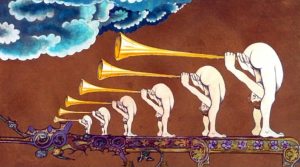
Stages:
In the podcast, I mention some of the many people who have come up with stages for various aspects of human life. Here is a brief review if you want to delve into that side of things:
Jean Piaget: Piaget was a Swiss psychologist who developed a theory of cognitive development. He proposed stages about how children aren’t just “learning more facts;” rather, they’re developing entirely new mental structures as they grow and change. For example, at a certain age, a child who sees 2 balls of clay, each with the same amount of clay, will think one of the balls rolled into a log will then have more clay. Like, really insist on it. Isn’t that amazing? As the child grows, he/she recognizes that not adding/taking clay means that the ball and the log have the same amount of clay. But they insist the log weighs more than the ball, because it is longer. Eventually the child learns the laws of conservation and see how the balls remain equal when no clay is added or taken away.
Makes me wonder what stage of cognition humanity is in.
Erik Erikson: Erikson focused on psychosocial development across the human lifespan. He saw development continuing throughout life, not simply ending in childhood. He had eight stages: each involves a central crisis or tension to resolve. Examples include trust vs. mistrust (infancy); identity vs. role confusion (adolescence); generativity vs. stagnation (middle adulthood).
Lawrence Kohlberg: Kohlberg focused on moral development, proposing six stages grouped into three levels: pre-conventional (focused on punishment and reward); conventional (focused on social approval and law); and post-conventional (focused on universal ethical principles). He built on Piaget’s work and applied it to moral reasoning.
Carol Gilligan: Gilligan challenged Kohlberg’s male-centered framework and her work questioned whether stage theories were universal or rather culturally-specific and/or gender-specific. She proposed moral development might follow different patterns for women, emphasizing an “ethic of care” alongside Kohlberg’s “ethic of justice.”
I also briefly researched:
Lev Vygotsky, a Soviet psychologist who proposed stages of cognitive development that emphasized social and cultural context.
Jane Loevinger and her theory of ego development. Her stages ranged from pre-social and impulsive (infancy) through to autonomous and integrated stages (adulthood).
Robert Kegan proposed stages of the evolving self, describing how our “subject-object balance” changes throughout life. Hmm…subject/object? Sounds familiar.
For further consideration:
Dreyfus and Dreyfus, developed a five-stage model of development of motor skills. It can be applies to all kinds of learning. Seems obvious once you see it, but the one who lays it out gets the credit.
- Novice- Follows the rules
- Advanced Beginner – Begins to recognize patterns
- Competent – Can make conscious choices about what matters
- Proficient – Knows what to expect; more fluid decision-making
- Expert – Just “knows” what to do
There is also The Four Stages of Competence model:
- Unconscious incompetence – You don’t know. And you don’t know what you don’t know.
- Conscious incompetence – You realize how much you don’t know
- Conscious competence – You can do it, but with effort and attention
- Unconscious competence – You can do it and no longer have to think about it
Like I said in the podcast, after I read and researched all of this, I ended up not using it hardly at all. That’s when I went in the “head up the butt” direction.
I would call that Advanced Beginner.
The clip from the song
“Easy To Be Hard” is from the original soundtrack of the musical “Hair,”.
On a more personal note:
My father took my brother and I to see a traveling production of Hair in our home state of Connecticut in 1972. I was 12; my brother was 10; we were pretty shocked at the end of the first act.
Here is what shocked us: Just before the intermission, the cast had been in a circle, singing while playing with a giant parachute, floating it up and down. As the song reached its crescendo, they disappeared under the fabric and let it fall down and drape them, covering them completely. They re-emerged at all once for the big finale. The entire cast stood naked in front of the audience for a full minute, finished the song and then casually walked off-stage for intermission.
Two innocent, sheltered kids met the hippies. I don’t remember exactly, but my mouth had to have been hanging wide open.
Thanks, Dad!
Episode 19: Deciding Together
Released on January 19, 2026
PODCAST BLURB
I imagined a reality TV show where 100,000 people decide together: what should we all do with $10 million?
If you are interested in manifesting this show, please see the final section below where I legally give you this idea in a show notes contract.
EPISODE 19
SHOW NOTES FOR E19
The root idea
for this podcast was first published on my now-mostly-forgotten Substack Off The Cushion. I was trying to combine conceptual art with politics. You can read the original here: “Conceptual Political Art #3.”
Just by the way
the name of my publication, “Off The Cushion,” came from the way people who meditate sometimes talk about being “on the cushion” while meditating. Then, when that round of meditation is over, you get up. Maybe you do some walking or stretching; maybe you sit back down. When you are done meditating and ready to carry on with your day, then you bring your practice “off the cushion” (i.e., live the rest of your life.)
I hardly do anything on Substack anymore, but you may find something of interest if you poke around. Here is the home page of Off The Cushion if you want to explore.
A remote possibility
If this idea about Deciding Together ever did work, the next thing I would encourage is a discussion about abortion. That’s so hard for people to talk about together! But I would rather see us try that than watch politicians use this issue to divide people against each other.
Hi Dad!
My father passed away in 2013 at the age of 83. Thanks for the idea for the podcast! I still miss you.
Shattered
The clip with “You must be tough, tough, tough, tough, tough!” is from the Rolling Stones song, “Shattered,” which appeared on their 1978 album Some Girls.
A legally binding contract (as far as I’m concerned):
SECTION 1:
I consider the words in this section of this show note to be a legally binding contract with anyone reading who 1) likes this idea and 2) wants to make it happen.
I say, hereby now and forever, with complete legalese blah, blah blah:
Go for it.
SECTION 2
You want this idea, it’s yours. You don’t have to pay me.
SECTION 3
That said, if you do want to pay me, I promise not to say no.
SECTION 4
Section 4 does not exist.
SECTION 5
If you want to give me credit for the idea but no money, totally fine.
SECTION 6
If you want to just flat out steal this idea and not mention me at all, that seems pretty cold. But you have to live with you. If that’s what happens, I promise to raise my eyebrows, shrug, take a deep breath and sigh. And then let it go.
Episode 18: A Slow Motion View Of Mental Fear
Released on January 12, 2026
PODCAST BLURB
Definitions:
Physical fears: ultimately of annihilation, based on perceived existential threats to actual physical survival.
Mental fears: ultimately of annihilation, based on perceived threats to the mind’s centrality in its self-created realm.
A slow-motion view of mental fear shows it’s never about what the mind believes it to be about. But it can feel the exact same as a physical fear. Let’s take a look.
EPISODE 18
SHOW NOTES FOR E18
Many of the ideas I riff with in this episode come from Hubert Benoit’s 1955 excellent book Zen and the Psychology of Transformation (see Chapter Five, “The Mechanism of Anxiety”).
Benoit was a French psychiatrist who learned something about Zen and then wrote a book about his understanding. I had to read it once or twice per year for ten years before I felt like I understood even 5% of it. I now consider it the most complete picture I’ve encountered of…let’s call them… the conditions preventing us from perceiving reality as it is.
“RUN AWAY!!”
Of course, that’s a clip from Monty Python and The Holy Grail, the scene where the deadly rabbit terrorizes King Arthur and his crew. The “run away” bit is in about 2:30 or so.
Marshall McLuhan
Marshall McLuhan published Understanding Media: The Extensions Of Man in 1964.
It’s an amazingly prescient book. I highly recommend it.
I can also recommend Episode 149 of the podcast Philosophize This! as a great introduction to the ideas of McLuhan. Here is an excerpt from the blurb on the episode’s website:
“Drawing from McLuhan’s favorite metaphor—Poe’s “Descent into the Maelström”—the discussion frames modern life as a kind of vortex in which people must study the patterns around them to navigate change. McLuhan viewed media not in terms of content, but in terms of their broader cultural effects—how they alter the scale, pace, and patterns of human experience. The shift from oral to literate societies, and now to an electric, interconnected world, dramatically changes how we communicate, think, and live.”
Representation & Reality
For an example of how easy it is to get confused between representation and reality: consider what I said in the podcast about René Magritte‘s painting being “in the show notes.” I noticed it during the editing. At 13:22 I actually say the words, “I put that painting in the show notes, in case you’ve never seen it.”
Of course, I can only put a representation of the painting here in the show notes. I don’t have access to Magritte’s actual painting. The original work is on display at the Los Angeles County Museum of Art. But even if I did have access to it, I still couldn’t put that painting in the show notes. I can only upload a digital representation to a website.
How easy it was to speak about a photo as the actual painting. In the midst of pontificating on the topic of confusing image and reality, and exactly while mentioning a painting that depicts this confusion, I still got it mixed up.
Here is a copy of a representation of Magritte’s painting about representation.
The Treachery of Images (1929)

This is the other painting (er, I mean copy of a representation of a painting) I mentioned:
The Human Condition (1933)

Speaking Of Representation:
At some point in the episode, I state that the mind is only about representation and does not perceive directly. I also say the body does not represent things. This is not true at all; it’s just one of those things you say when you wish to make a point. I want to present here a brief explanation of why I said it anyway.
Let’s look at the difference between how the body and the mind each represent things.
The body of course “represents” things, meaning the eye turns light into nerve impulses which are then translated by the brain into what is seen. The ear turns vibrations into nerve impulses as well and then represents sounds. All human senses are the translation of direct physical phenomena of an actual world into internal representations of that actual world.
The mind also represents things, but in a way closer to what we think of as representation. The mind uses symbols to represent things. These symbols are connected to other symbolic meanings, like context, history, culture, etc. The body, when it represents things, is simply and only representing; the body does not make symbols.
The human body perceives a chair in a very similar way that a cat or a monkey or a squirrel perceives a chair. The human mind makes the body’s perception of “chair” and turns it into the symbol CHAIR. Now the mind can add thing about the chair and about the things we “know” of the chair: its color, its type, the materials it’s made of, perhaps memories of who sat in the chair, and so on. Feelings (kind of an intermediary between body and mind) about the chair can develop as the mind layers and connects meaning to its symbol of the body’s perception.
So one can certainly say the body makes a representation of the world. But it seems better to say the body isn’t representing at all, but is perceiving directly. For this story, I wanted to focus on how the mind is a complex, layered and largely self-centered maker of representations.
Please remember that
you can leave me a voice message or send an email. I would love to hear from you!
Episode 17: The Tree Of Acceptance Of Dying
Released on January 5, 2026.
PODCAST BLURB
This episode is possibly NSFW. There are a few F-bombs somewhere in minutes 12 thru 14.
As a retired hospice nurse, I saw many patients who accepted death in general, but struggled with the specifics in the process of dying. For example, the slow decline, the gradual loss of abilities, the clear truth that they were not in control, were often quite difficult to accept.
The Tree Of Acceptance Of Dying is designed to help people cultivate both acceptance of death and the process of dying.
This is the podcast version of an essay I wrote in 2023.
EPISODE 17
Denial: 10:20
Anger: 11:29
Bargaining: 15:16
Sadness: 17:30
Acceptance: 21:07
SHOW NOTES FOR E17
ORIGIN OF THIS EPISODE:
In the spring of 2023, Ellen Long Stilwell told me she wanted to write another book. (She’s the author of “Love Death Love.”) Ellen and I, both RNs, worked together on a hospice team in New York City over the course of several years. I was about to retire that spring when Ellen told me, for her next book, she wanted to collect essays: from the doctor on our team, from the social workers, from the chaplains, and from other nurses.
She asked us all this difficult question: “How can you know when you (or a loved one) are ready for hospice care?” Our essays and Ellen’s effort resulted in the book Hospice: A Different Type of Hope. It is available for purchase this book at any of the links below. If you (or anyone you know) needs help thinking about hospice and nearing the end of life, this book is a great resource.

The Tree Of Acceptance Of Dying
was my answer to Ellen’s question. The original essay was first published on Substack in June 2023 and appears as a chapter in Ellen’s book.
Just so you know, I don’t do much with that platform anymore. But this essay was, by far, my most popular post on that site.
DO NOT GO GENTLE
The poem by Dylan Thomas, Do Not Go Gentle into That Good Night, sums up many people’s approach to the end of life. What most don’t realize is that Dylan Thomas was 33 when he wrote that poem. His chest condition would sometimes make him cough so hard he turned purple. He died when he was 38. That’s certainly young enough to keep fighting to stay alive and not “go gentle into that good night.”
If Dylan Thomas had been alive in 1994, he would have turned 80. It’s quite possible by then he would not have fought “that good night” as hard as his poem advises. We’ll never know.
The reading I quote in the episode was by the actor Michael Sheen.
Do Not Go Gentle into That Good Night, by Dylan Thomas
Do not go gentle into that good night,
Old age should burn and rave at close of day;
Rage, rage against the dying of the light.
Though wise men at their end know dark is right,
Because their words had forked no lightning they
Do not go gentle into that good night.
Good men, the last wave by, crying how bright
Their frail deeds might have danced in a green bay,
Rage, rage against the dying of the light.
Wild men who caught and sang the sun in flight,
And learn, too late, they grieved it on its way,
Do not go gentle into that good night.
Grave men, near death, who see with blinding sight
Blind eyes could blaze like meteors and be gay,
Rage, rage against the dying of the light.
And you, my father, there on the sad height,
Curse, bless, me now with your fierce tears, I pray.
Do not go gentle into that good night.
Rage, rage against the dying of the light.
A STATISTIC
Here is an important statistic from the original essay (but edited out of the podcast.)
The statistic comes from a December 2022 report by the National Hospice and Palliative Care Organization (italics are mine):
Half of the people who elect hospice are on the program less than 3 weeks.
Hospice care is available her in the United States for anyone who is within six months of the end. What this means is, for many people, six months or so away from death, the difficult questions “Should I continue to fight” and “Is it time to let go?” never get asked.
ELIZABETH KUBLER-ROSS
Elizabeth Kubler-Ross’ five stages of grief have come into some criticism, which I find a bit misguided.
From wikipedia:
“Misapplication can be harmful if it leads bereaved persons to feel that they are not coping appropriately or it can result in ineffective support by members of their social network and/or health care professionals.[1][37] The stages were originally meant to be descriptive but over time became prescriptive. Some caregivers dealt with clients who were distressed that they did not experience the stages in “the right order” or failed to experience one or more of the stages of grief.”
When a model is not used well (“originally meant to be descriptive but over time became prescriptive”) that’s not the fault of the model. That’s on the practitioners who used it that way. A good model can only provide a useful framework; it needs to be lightly held, gently used and easily tossed away.
Elizabeth Kubler-Ross’s 1969 book On Death And Dying was a great inspiration to many, including myself. I believe it helped shift our culture in a good way and started many conversations we are all much better off for having.
DENIAL OF DEATH
Our culture pays attention to and rewards, almost exclusively, youth and growth and new life. Our culture creates stories about who we are that leave death almost completely out of the picture. And by leaving death itself out of the picture, we certainly leave out the process of dying. The gradual and inevitable loss of every fruit on the Tree is just not on most people’s radar.
Ernest Becker’s 1973 book: The Denial Of Death is a great resource for anyone exploring…well…I guess you could call it the denial of death.
ABOUT HOSPICE
If you decide to enroll in hospice, you sign some papers and you start to receive your hospice benefit. It is, at its most essential, simply a form of insurance. State by state, hospice by hospice there are many different ways this program is administered, but the overarching goal is for home hospice care to be available to all. You trade aggressive treatments for home visits by nurses and, if you wish, social workers and chaplains. A doctor is always on call. Your hospice medications are delivered to your home (non-hospice meds you still have to get yourself.) You can also get medical equipment (like a hospital bed, oxygen concentrator) delivered to your home.
Check with you local hospice for details, ask any questions, etc.
LIFE AFTER DEATH?
Due to wanting to focus on acceptance, I excluded from the podcast any consideration of what may happen to an individual after death.
For me personally: I see life in this universe as so profoundly improbable I feel ready for anything after death. I can imagine a welcome into Heaven, or Hell, or complete nothingness. Death means at least this: any and all current bodily functions will cease. Even if a soul survives the body and can see and hear and talk, I still think that, some day, the life of a soul must also come to an end. I believe there is no escape, no matter what the timeline, to some kind of death. This will be true whether your lifespan is 100 years or 100 million years.
So let’s all agree, in a narrow view, on what being dead means. From the very first day that you’re dead, your body will have no more of the capacities you had when you were alive. On the second day that you’re dead, same thing. Body still dead, still no capacities. Third day, same thing, none of your bodily capacities will manifest. When your body dies, it’s going to be dead for millions, nay billions of years.
I address this in The Ten Crutches Podcast Episode 14, which was called Five Things that Make It Hard to Be Human. The fifth one is called “Fleeting vs Eternal” and takes up this issue directly.
A STORY ABOUT ONE PATIENT OF MINE
When I admitted Jane to hospice, she was completely relaxed and genuinely accepting of her life coming to an end. She was a perfect example of a life well-lived. Jane was strong and intelligent, had great sense of humor and loved to share her hard-earned wisdom.
In her early 70s, Jane received a cancer diagnosis. She did the chemo and radiation, which was a huge struggle for her. But the treatment worked and the cancer was gone. She returned to her life and lived ten more healthy (and fun) years.
Now in her early 80s, a routine checkup revealed the cancer has returned. While deeply grateful for the “extra” years, Jane was certain: she didn’t want to go thru all those treatments again. She was one of those people that thought clearly about death and had fully accepted they were going to die.
The story is about what she missed.
As a cancer advances, of course you get weaker and weaker. As you get weaker, you are still able to walk. Over time, however, you walk less far. You walk less often and with more effort. If you simply look, it’s obvious where the weakness is leading: eventually, you won’t be able to walk at all.
Jane once reminisced with me about how, earlier in her life, she’d walk up and down the entire length of Manhattan with her husband. (That’s a little over 13 miles.) When I met Jane, it was many years after that, but she was still able to walk about five blocks.
After about a month on hospice, I asked her how far she was walking. Her answer startled her. It was around 3 blocks. She hadn’t realized her capacity had gone down.
It saddened her, but she still would not think about where this was headed.
She loved to walk. She loved being outside. She lived in a great neighborhood. She especially loved being able to move around her apartment independently. She was not consciously aware that the gift of walking would be gone while she was still alive. She accepted her overall death, but not the death of her ability to walk.
For 8 decades, every time Jane had needed to get to the bathroom, Jane went there herself. She thought she could keep walking around until one day she’d just lay down, let go and be dead. But that’s not how it works.
Part of my job as a hospice nurse was to help Jane foresee she needed to prepare for not being able to walk.
At some point, somewhere along the arc of being able to walk 13 miles to being able to walk 5 blocks to being able to walk 3 blocks to eventually being dead (and clearly not being able to walk at all)…somewhere on that arc of decline, you will need help. Someone is going to have to help you get to the bathroom or to a bedside commode.
I kept introducing this subject to her, and Jane understood it, at least intellectually. I made Jane promise me she would call someone for help in the middle of the night. And for a week she did. But then, in the middle of the night, thinking just this time she could make it to the bathroom by herself, she didn’t call her aide to help her. She didn’t want to be a bother.
Jane fell in the bathroom and broke her hip. This added a thick layer of unneeded discomfort to her last few weeks.
Wonderful, wonderful person. Jane was a writer with several published books. She gave me great advice about writing. And taught me a lot as well about how to face the end with gusto and dignity, even with a broken hip.
3 RESOURCES
The Centre For Sacred Deathcare
From the website:
“We’re a vibrant community of learners and seekers who gather to share our curiosities, passions, insights, and experiences. We’re committed to creating a death-positive culture where transformative loss is honoured as an important part of our soul’s evolutionary journey.”
“The Centre for Sacred Deathcare was founded to help people meet death–and life–in ways that are more healing, and more whole. Our work is dedicated to the health and well-being of our collective past, present, and future.”
Being Mortal, but Atul Gawande.
From the website:
“Medicine has triumphed in modern times, transforming the dangers of childbirth, injury, and disease from harrowing to manageable. But when it comes to the inescapable realities of aging and death, what medicine can do often runs counter to what it should.”
Making Friends with Death, by Judy Lief
From the website:
“In Making Friends with Death, Buddhist teacher Judith Lief, who’s drawn her inspiration from the Tibetan Book of the Dead, shows us that through the powerful combination of contemplation of death and mindfulness practice, we can change how we relate to death, enhance our appreciation of everyday life, and use our developing acceptance of our own vulnerability as a basis for opening to others. She also offers a series of guidelines to help us reconnect with dying persons, whether they are friends or family, clients or patients.”
If you’d like to share
anything related to hospice, death & dying, this podcast, whatever: I would love to hear from you. Please email me or send me a voice message.
Episode 16: Being One, Being Separate
Released on December 29, 2025.
PODCAST BLURB
What is happening in your life? Are you intimately “one,” manifesting a unique aspect of this great universe? Are you a separate and ultimately alone individual? Both?
EPISODE 16
SHOW NOTES FOR E16
At some point during this episode,
during my riff about cults, I say:
“This pitch plays on our deepest longings to recognize and live from the oneness we somehow know is ours. To want to escape from our social conditioning can be a stepped-down version of wanting to escape from the conditions that keep us locked into our separateness.”
I just wanted to make it clear: wanting to escape from our initial social conditioning is an important and valid thing to do (when it is.) Each person will decide this for themselves, in light of their own values and experience. Ironically, people also decide in the light of the social values they have inherited as well.
At least some of our social conditioning trains us to accept maltreatment, not only from from individuals, but also (perhaps especially) from social systems. Not only that: we are conditioned as well to participate in many social structures that both accomplish and perpetuate the maltreatment. Well worth undoing!
Personally, I’ve worked quite a bit over the years to undo much of my harmful original personal and social conditioning as I could. It felt at times as if there was very little I wanted to keep. At times, the “un-doing” was successful; other times, not so much.
But to reinforce one last time: any desire to change my conditioning, based in any way on wanting to undo my individuality and “achieve” oneness, was on the wrong track.
At another point
I say something about how we are “acting out our very personal versions of our society’s issues.”
A clarifying example: a societal issue might be something general, like the struggle between men and women, a struggle going on for millennia. As I see it, all of us, me and you and everyone, as a man or a woman or however you identify, participate fully in this species-wide, millennia-long discussion. We explore this issue together, each from our particular variation of DNA & family & culture & upbringing & relationships & predilections, etc. We explore by: agreeing or disagreeing with what we’ve been taught; accepting or rejecting other ideas and people we are exposed to; cultivating or neglecting particular practices, etc., etc.
I find this (viewing my particular personal issues as one variation of greater social issues) a great lens to view being one/being separate. Whatever ideas about gender and identity you have, you can easily find those who agree with you and those who disagree. However certain you are in your position, however right you feel, there is sure to be someone will honestly believe you are wrong, harmful and destructive in your beliefs.
At such a time, where is individuality? Where is unity?
One critique
I will make of this episode: leaving out any mention of the positive function of a teacher.
It’s quite clear that no teacher can help you become “one with everything,” since you already are. But the places we look that will answer our questions, the tricks we play on ourselves with our egos and our perceptions, the traps we get stuck in without realizing it: these are great reasons to find a guide to help you along.
A good teacher can help you move out of the dead-ends and start to live where you already are.
Episode 15: Dreams Of Creativity
Released on December 22, 2025.
PODCAST BLURB
Creativity is a superpower and we all have it. Why isn’t it easier for all of us to own it? And use it in the midst of our lives? I explore how our ability to dream at night can cultivate creativity that flourishes during the day.
EPISODE 15
SHOW NOTES FOR E15
First Thing:
Are you someone who has never seriously tried to remember and record your dreams? At least for a time?
I strongly encourage you to do a little research and find a technique that suits you. A journal at your bedside. A recorder within easy reach. Try to remember your dreams! Keep a dream journal, at least for a month or two. The things we are thinking about at night can range from the chaotic to the trivial to the deeply personal to archetypally profound.
Check it out! This is your mind dreaming at night, We use the animating energy of the universe to move things around in our minds. It’s worth exploring.
Second Thing:
I have certain guidelines I follow when I make podcasts. They are a compensation. They balance my tendency to want to be perfect.
For example: I never to go back and re-record after I finish the initial recording of an episode. Once I record an episode, that’s it, baby! I force myself to take whatever I recorded and edit only that. If something is missing, or doesn’t sound 100%, then too effin’ bad. After recording, I become only an editor and pretend the guy who recorded this imperfect track left town and is unavailable.
Like I said: I put limits on my perfectionism; otherwise, I might be back and forth with an episode, tweaking it here and there forever. I’d never be able to release any episodes at all, since none of them will never be perfect.
So: a good thing about show notes is that the editor (me) can write here what the voice (me) missed in the recording session because the writer (me) didn’t put it in the script.
What I Missed In The Recording Session
I focused on storytelling as the way to encourage people to identify as being incredibly creative. But sometimes we just have fragments of a dream. What if there isn’t really a story to a dream?
I believe when you write out a fragment of a dream, you have a poem.
We are all poets!! And that’s in addition to being storytellers. Screenwriters? Directors? Choreographers? Dreams manifest all of human creativity. There is no end to our creativity.
A Dream Fragment Poem I Had Last Week
Up above us, in the sky,
it wasn’t a spaceship,
but rather swirls of clouds and crystals,
huge and circular.
And we were all looking at it
when dead birds began to fall,
some of them into the swimming pool.
I asked the people I met later,
“Did you see them? Did you see the dead birds?”
Episode 14: Five Things That Make It Hard To Be A Human
Released on December 15, 2025
Episode 14
SHOW NOTES FOR E14
These five aren’t really “things:” they are more like conditions we find ourselves in, or perhaps like polarities we must manage.
I identified five that are tough for me. I share them here with you.
#1 NOT KNOWING WHAT SIZE WE ARE
Starts at 2:59 – We are tiny and we are huge, ultimately of indeterminate size.
#2 MISSING OUT
PART A – starts at 6:15 – Our senses appear, subjectively, to be filled. And yet we miss SO much of the reality going on around us.
PART B – starts at 9:37 – Time Windows.
#3 NEEDING TO BE CERTAIN IN AN UNCERTAIN UNIVERSE
Starts at 11:51 – We humans develop a deep capacity for certainty, perhaps even a deep need to be certain. Yet we live in a universe of uncertainty. This can lead to lots of denial.
#4 FRONTAL LOBE ISSUES
Starts at 14:16 – Our imaginations are an amazing gift. Yet they can (and do and will continue to) blind us to reality.
#5 FLEETING vs ETERNAL
Starts at 17:30 – Many experience the human lifespan as fleeting. And compared to the life of the universe, they certainly are. And yet time, as measured in hours and days and years, is nothing but a grid we overlay on eternity.
NOTE: I am not talking about “eternal” in terms of anything religious. It refers only to the universe having no beginning and no end. The universe clearly includes the grid of time we overlay on it, but does not (could not) function only within that grid. When it comes to eternity, there is nothing to wait for. Where else could eternity be, except right here? When else could eternity be, except right now?
Shout out to Belinda Carlisle
(and also to MCA records) for the fair use of the edited clip from “Heaven is a Place on Earth,” released in 1987.
TIDBIT
A 12 second “Behind the Scenes” clip from getting ready to record this episode
MASLOW’S HIERARCHY OF NEEDS
I wanted to speak about Maslow at the beginning of the episode, but then didn’t. If you never heard of him or his Hierarchy, that simply means you never took a Psychology 101 class (or you did and weren’t paying attention.) Here’s a link to find out more. I wouldn’t argue one way or another about whether or not it’s true, but it sure can be a useful framework to assess where someone is at.
FAITH VS BELIEF
I almost mentioned during #3 (“Feeling Certain in an Uncertain Universe”) that I see a tremendous confusion between Faith and belief. I am planning to create some episodes about this, possibly a 3 or 4-part series, but it won’t come out for a while. All of have at the time of this writing is a jumble of notes, waiting patiently to become a script.
One huge example of certainty gone wrong is when so-called religious people want to impose their religion on others, or think people different than them are infidels. I name this “so-called religion” because forcing people to be certain in what you are certain about is simply childish, it’s not religious.
I see people with huge certainty walking around with a cardboard tube, like the ones inside rolls of paper towels. They look at the world only thru this little tube. They can certainly see some of the world, swing their tube around and get some sense of what’s going on. But they miss out on so much! And, I find, miss way too much to justify being so certain. They only catch glimpses of things and then impose (with certainty!) all their stories on the rest of the world.
I wish they would try to let the tube down, for even a moment.
Episode 13: The Mistake Of Directly Cultivating Patience
Released on Monday, December 8, 2025.
PODCAST BLURB
Apparently, it’s quite easy as a human to feel impatient. Many impatient people, in order to counter this tendency, try to cultivate patience. I used to do this all the time.
I now regard this as a mistake. In this episode, I present how I currently approach the situation.
Episode 13
SHOW NOTES FOR E13
The Inspiration For This Episode:
Several years ago, a group of friends wished to cultivate patience over the course of a month. Deciding that direct cultivation was contraindicated, two friends in the group developed games and exercises for approaching patience indirectly. In fact, they approached it so indirectly, they often forgot what they were doing. But the guiding question was always about discovery: what will this series of exercises do to our patience?
So, for example, during their daily meetings, everyone there might be requited to speak as fast as they could. On another day, everyone had to leave a two-second pause between words. On another day the group was divided in half between fast talkers and slow talkers.
After a month of these kind of exercises, everyone in the 15-person group spent part of the morning watching paint dry with interest and curiosity and patience.
Shout Out:
To Dan Bern!! For his great song Jerusalem.
A Bit More About Patience
Here’s an overly concise overview of how some major religions approach patience. It’s mostly to show how common it is to try and be direct while cultivating patience.
Christianity
Patience is considered a key virtue. Christians view patience as enduring hardship with faith in God’s timing and God’s plan.
Cultivation: Through prayer and reading Scripture; by trusting in God’s providence; and viewing challenges as opportunities for spiritual growth. Job is considered a model of patience under suffering.
Islam
Patience (sabr) is emphasized strongly. For example, it is mentioned in the Quran over 70 times. Patience encompasses perseverance, self-control, and steadfastness in faith during difficulties.
Cultivation: Through constant remembrance of Allah (dhikr) and by performing the five daily prayers; fasting and practicing self-restraint during Ramadan; reflecting on worldly difficulties with an eye towards their temporary nature (versus eternal reward.)
Hinduism
Patience (kshama or titiksha) is an essential virtue in Hindu philosophy. It is defined as mastery over one’s reactions via acceptance of life’s dualities.
Cultivation: Through yoga and meditation practices,; by karma yoga (selfless action); by studying sacred texts; and by developing detachment (vairagya) from outcomes.
Buddhism
Patience (khanti in Pali, kshanti in Sanskrit) is one of the Six Perfections (paramitas) considered essential for enlightenment. It means bearing difficulties without anger or disturbance.
Cultivation: By contemplating impermanence (anicca); by developing loving-kindness (metta); and by recognizing that anger harms oneself. The practice of vipassana (mindfulness meditation) will help a practitioner observe difficult emotions without reacting further.
Judaism
Patience (savlanut in Hebrew) is valued as part of character refinement. It’s linked to concepts like trust in God (bitachon) and to acceptance of divine decree.
Cultivation: Through study of Torah, prayer, and reflecting on biblical figures who exhibit patience, like Moses and Job; by practicing mindfulness of God’s presence. The concept of “midot” emphasizes working on patience as part of ethical development.
The Age Of The Universe
I mention briefly, just after the intro music, that the universe is 13.8 billion years old. I got curious about how anyone could think that? Why 13.8 billion and not 12.8 or 14.8? Why not 6 days or 6,000 years?
This is just me nerding out on the research. I put it here in case you are interested.
Turns out that scientist determined the age of the universe through multiple independent methods. And, at least currently, they all converge on pretty much the same answer – about 13.8 billion years.
In the 1920s, Edwin Hubble discovered galaxies are moving away from us. Plus, the farther away they are, the faster they’re receding. This suggests the universe is expanding. By running this expansion backward (kind of like running a film in reverse), scientists could estimate when everything was compressed into a single point – the Big Bang.
Cosmic Microwave Background (CMB): In 1964, scientists discovered faint radiation permeating space, which they interpreted as the afterglow of the Big Bang itself. They measured tiny temperature variations in this radiation. From this, physicists determined properties of the early universe and calculate its age.
The oldest stars: Astronomers estimate the ages of the oldest stars with their theories of how stars evolve and die. These ancient stars are roughly 12-13 billion years old, which provides a minimum age for the universe (the universe must be at least as old as these stars.)
Radioactive dating: The decay rates of certain radioactive elements found both in meteorites and in Earth rocks reveals an age for the solar system (about 4.6 billion years). This in turn helps with an understanding of cosmic timescales.
Somehow, these completely different approaches all point to the same age range, which is around 13.8 billion years.
Episode 12: Aspiration Precautions
Released on Monday, December 1, 2025.
PODCAST BLURB
I originally heard the phrase “aspiration precautions” during my nursing career. In that context, aspiration is swallowing food down the wrong tube; it can go inadvertently into the lungs. A nurse teaches aspiration precautions to help caretakers and family members avoid this difficulty for a patient or loved one.
Meanwhile: we all have hopes and dreams. When it comes to the “spiritual” realm, I often find myself filled with aspirations. My aspiration is to become enlightened? I found some precautions were called for.
Episode 12
SHOW NOTES FOR E12
Here are the four ASPIRATION PRECAUTIONS I came up with and read at the end of the episode.
I try to keep them in mind, especially if I find my “desire to awaken” kick in. It can come while feeling inadequate, for example. It comes when I find myself greedily plotting to obtain a characteristic or experience or thing I don’t have. And, like a nurse explaining feeding precautions to an upset family member, I know my words won’t always have an immediate impact. But the precautions can help calm me down about my ambition overall.
They remind me: what I am most deeply searching for is already right in front of me.
#1:
Remember that making an effort to “become enlightened” cannot succeed. In the present moment, you already have whatever wholeness you might crave.
#2:
Remember that “awakening” cannot take place in the future. In the present moment, The F u t u r e is a mental construct we can use at our leisure. It is not a place where events occur.
#3:
Remember that “awakening” cannot take place “in the present.” In the present moment, the construct of saying “this is the present” takes you out of the present.
#4:
Remember to engage fully in reality without any ultimate goal. In the present moment, if the whole universe doesn’t need an ultimate goal, neither do you.
ONE INSPIRATION FOR THIS EPISODE
The wonderful book called Cutting Through Spiritual Materialism by Chogyam Trungpa came out in 1973. It was created from a series of talks was given in Boulder, Colorado in 1970-1. As the author says in the introduction, “Ego is able to convert everything to its own use, even spirituality.”
Here’s a paragraph from the first chapter:
“It is important to see that the main point of any spiritual practice is to step out of the bureaucracy of ego. This means stepping out of ego’s constant desire for a higher, more spiritual, more transcendental version of knowledge, religion, virtue, judgment, comfort or whatever it is that the particular ego is seeking. One must step out of spiritual materialism. If we do not step out of spiritual materialism, if we in fact practice it, then we may eventually find ourselves possessed of a huge collection of spiritual paths. We may feel these spiritual collections to be very precious. We have studied so much. We may have studied Western philosophy or Oriental philosophy, practiced yoga or perhaps have studied under dozens of great masters. We have achieved and we have learned. We believe that we have accumulated a hoard of knowledge. And yet, having gone through all this, there is still something to give up. It is extremely mysterious! How could this happen’? Impossible! But unfortunately it is so. Our vast collections of knowledge and experience are just part of ego’s display, part of the grandiose quality of ego. We display them to the world and, in so doing, reassure ourselves that we exist, safe and secure, as “spiritual” people.”
MORE ON MY PODCAST CATEGORY
I mention in the intro how I came to choose the “Spirituality and Religion” category for my podcast.
It is worth noting one way this podcast does fit into the “Religion” part of that category. The word “religion” comes from the Latin “re” (meaning “again”) and “ligare” (meaning “to bind” or “tie together”). I take this to mean that, in our separate state, we use something like religion (when it is used well) to help us all become connected again.
Many people associate religions with institutions that often don’t act in very loving and re-connecting ways. Nevertheless, in the original sense of the word I quote above, I do consider my podcast to be a religious podcast.
HOSPICE CARE IN GENERAL
For those who may be in need of hospice care (or who know a loved one who may need it), I refer you to this lovely book: A Different Type of Hope: Criteria for Choosing Your Hospice Team Sooner. The author, Ellen Long Stilwell, was an RN on my hospice team when I was seeing patients in Manhattan. She collected essays from our team (RNs, Social Workers and our team MD) and created quite the compendium of advice and support.
My own chapter in her book was originally an essay, which I would love for you to read. It’s called The Tree of Acceptance of Dying. I have made a podcast version of this essay that appears in Episode 17 of this series.
I’ll take a moment here to give a shout-out to all the amazing people I worked with as a hospice nurse. Our Manhattan team was a crew of exceptionally skilled nurses and social workers. Plus, we also had one of the best team leaders I ever had the pleasure of working with in my whole nursing career.
MORE ON NURSING AND ACTUAL ASPIRATION PRECAUTIONS
I first became an RN in 2005 and retired from professional nursing a few years ago. During my career, I spent many years as a hospice nurse. I visited and cared for my patients in their New York City apartments as they approached the end of their lives.
One thing you learn as a hospice nurse is that, as the body shuts down, food is usually needed less and less. So when people near the end of life, getting weaker and weaker, they often lose the ability to swallow. This is a very common occurrence; it’s often OK with MOST patients because they aren’t all that hungry anymore. It’s all part of the very natural mechanisms that prepare a body to come to the end of being alive.
However, it is often deeply distressing to family members. Any desperation about losing this person can get funneled into wanting to feed them.
Many cultures consider food identical to love. Many see the patient’s lack of hunger, or the lack of eating, as hastening the death, even causing the death, rather than being the result of an advanced disease (or whatever the condition is that put them in hospice.)
So what develops sometimes is that caregivers actually believe forcing food is helpful somehow to a dying person. I have heard “You have to finish your applesauce!” said to patients who are just a few days away from dying, (and who never even said they were hungry, in fact tried to decline the applesauce.) I have seen patients go along with someone feeding them simply because they felt it would be too harsh to stop the person feeding them and present them with the truth: I’m not hungry. I am dying.
On another hands, there are many situations where people are indeed hungry; but they are weak and, for whatever reason, cannot swallow well. So again, there is a risk of choking. Food going down the wrong tube, going into the lungs instead of the stomach. This has the clinical name: aspiration.
This is why we nurses developed a set of instructions called “aspiration precautions.”
THANK YOU
To Alan Watts and Ram Dass. Both excellent teachers and both very helpful to me, not only for this episode, but across my entire journey.
Episode 11: Self-Criticism, Born Of Perfectionism
Released on Monday, November 24, 2025
Episode 11
SHOW NOTES FOR E11
About Self-Evaluation & Letting Go Of Punishment:
Let’s rename “legitimate self-critique” and call it “self-evaluation” instead. This will distinguish it more clearly from self-criticism. I mention in the podcast it’s important to recognize your behaviors can, at times, cause harm, or at least have effects that you wish to correct for. Sometimes your behavior needs self-evaluation and needs to be changed.
In any case, it’s best to evaluate your behavior without being punitive. Hopefully, you can be somewhat objective about what you’ve done (or haven’t done). And also somewhat objective about the impact that this has had in the world.
It’s possible to evaluate our behavior and it’s impact in a fairly impartial way, like a good parent would. I recommend avoiding judgment and being punitive. Judgment leads to punishment; judgment implies punishment. People often act like they are in a court of law when they self-evaluate. They find themselves “guilty” of doing something wrong. Then they become the judge that sentences themselves to feeling bad about the whole thing. Or even worse than feeling bad: there can actually be harmful behavior inflicted by the self onto the self as punishment.
We are usually very harsh on ourselves when we judge ourselves to be bad or wrong. This then becomes a reason to avoid any self-evaluation. Under these conditions, who would want to own a mistake?
That’s why I recommend to self-evaluate without punishing yourself.
Just explore what was happening for you at the time of the behavior. Of course, easier said than done. But unless you can dig a little and find some of the previously unconscious reasons for why you acted the way you did, those reasons will stay buried and tend to make you run the same behavior. Then all you can do is promise to “try to do better next time.” But all the reasons you had to do it in the first place remain intact.
Self-evaluation is needed by everyone from time to time.
Self-punishment, or feeling bad about whatever-it-was we did, blocks any honest self-investigation. When our attention is on feeling bad, or threatened by feeling bad, we don’t have much motivation to impartially explore how/why we acted, to look honestly at ourselves in retrospect, trying to uncover what it was that made us act in a way we now evaluate as lacking.
I call this a simple adult behavior in the podcast because I believe that’s what it is. It’s simple (not complex). But not easy to do. Particularly in a culture that refuses almost categorically to take responsibility for individual actions, much less actions that participate in social constructs that oppress others.
About The Bonus Track At The End Of The Episode:
I made that bonus audio track in 2023. I was fascinated to hear it again after I recorded the podcast. I saw some of my ideas had shifted; others were emphasized; others had been dropped.
The track is one in a collection of 20 tracks called Dagger Does Audio. The fictional character, Dagger Jameswood, is the hero of my first and only published science-fiction novel. After some encouragement from family, I turned the novel into an audio book. That was a steep learning curve, to be sure, but by the end I found myself hooked on making audio. When it came time to name my new collection of tracks, I used my fictional hero’s name. I imagined he was the one that had made all these tracks.
The audio tracks range from the very silly
Pizza Delivery Man
To the silly but all-too-real
Tour Of My Mind
And then there were ones I didn’t know how to categorize (Social commentary? Satire? More silliness?)
You Are Unique
By the way, that sci-fi novel that started all my audio adventures is called Dagger Jameswood Enters the Fourth Dimension. It is (imho) a fun, light read. It has a quirky main character on quite the adventure. It is available as an ebook, an audiobook or as a paperback in case you’re interested.
Thoughts About Needing Help When Self-Criticism Is Too Harsh
Of course, simply coming into the present is NOT a one-size-fits-all solution for anyone and everyone. We all have to take care of business, as I allude to in the podcast when I say exploring all your different parts is important and valid. “Know Thyself” has been excellent advice for many centuries.
It’s essential to be able to see when you can use outside help: perhaps some therapy? Talking with a friend. Cognitive Behavioral Therapy is a great place to start. Who knows? Certainly not me about what will best help you. It depends how destructive the self-criticism is in your life and what it will take for you to make it manageable. I don’t know that it can ever disappear completely.
The most important thing is to recognize you can use some help and the get some.
And Remember: It’s Not Always The Individual That Needs Help
I want to mention here that our economic systems, many of our social structures and our general culture directly support harmful self-criticism. Putting pressure on women for how much they weigh is but one example. These social considerations were beyond the scope of this particular episode, so I only focused on what we can do as individuals.
Nevertheless, when you honestly evaluate your own behavior, it is always possible to see larger social forces having a strong influence on what you do (and don’t do.) There is no way around this. We are all social creatures acting together, kind of like raisins in a jello mold. One wiggle makes us all wiggle. (It’s just that some of us raisins are particularly good at making the whole jello wiggle and that these particular raisins hardly ever wiggle with the benefit of all in mind.)
By talking in this podcast about how you personally can side-step destructive self-criticism, I didn’t mean to suggest that these social forces are trivial. They are not. It’s truly important to recognize our culture plays a huge part in what “seems obvious” for us to like and dislike about ourselves.
These are titanic social forces use whatever inadequacy we tend to feel, ramp it up and then keep it ramped up. We all contend with this. Please cultivate awareness of these social forces and let yourself off the hook for any susceptibility you have for going along with the impossible standards of the herd.
Some Final Notes On Actually Practicing With This
There are many different techniques out there, but “coming into the present” is never a technique.
Whether you’re at work, in the car with your kids, wherever you are, you can always practice being the present: That’s because you are always in the present. There’s nowhere else to be. It’s not a technique to be present. It’s just simply noticing where you already are. This is always available to you.
But if you do want a technique for the next time you find yourself steeped in self-criticism, here’s one to try out:
- Come “into the present” as best as you can. Look at what is around you. Hear the current sounds in your immediate environment. Ignore any other humans for the moment.
- Say to yourself, “OK, here I am in the present.”
- Say to yourself, “I am looking and listening to everything that is present.” And then keep doing it.
- Ask of this (non-human) environment, “Tell me if I am worthy or unworthy.”
- Stay as present as you can after you ask the question.
- Recognize that this non-human environment does not understand this question at all.
- Recognize that outside human society, which is the vast majority of the universe, this question has no meaning at all.
- Use this insight to put your concerns in perspective.
When you are really using all of your attention on the present, seeing actively with your eyes, hearing actively with your ears, then there is often no further room in your attention for a voice to call you unworthy. (And, for that matter, neither is there room for a voice to call you worthy.)
Letting go of self-critical voices in any given present moment is not a direct effort. It’s a by-product of paying attention.
My recommendation is to try this exercise alone or in a small group of people you trust, who understand this is what you are doing. Start small and simple.
The most important thing is to see and then practice how coming into the present cuts thru all the voices. The positive voices and the negative ones are all having a war, but you can simply exist in the present. Let them be like TV from a neighbor’s apartment, where you can’t quite figure out what the show is, but it doesn’t really matter, because you have better things to pay attention to. Or like rain on the roof you can hear, but doesn’t make you wet.
Stopping the self-criticism for a time gives you a valuable perspective. But then you still have to dig in and do the work.
Episode 10: The Subject/Object Split PART 5: The Present As In-Between
Released on Monday, November 17, 2025
Episode 10
SHOW NOTES FOR E10
I know for some, facing the issues I raise in these Subject/Object Split episodes will not be easy. I find the best way to address the subject/object split is with the support of a community who can relate to these issues. What has helped me the most in my own struggle has been Zen Buddhism. There are truly amazing teachers who have taken on teaching the dharma. If you are inclined to check out Zen, I heartily recommend doing so. While it’s certainly not a good match for everyone, those who like it can potentially find a warm and welcoming home in a zen center. If you decide to look, I am hopeful you will find a good center near you.
A QUOTE
This quote from Jesus shows that these ideas about uniting the subject and the object are quite old.
When you make the two one, and
when you make the inner as the outer
and the outer as the inner and the above as the below…
then shall you enter [the Kingdom]
ABOUT THAT RECORDING AT THE VERY END
The recording I play at the very very end of the episode (after the Outro) is called “Subject/Object.” If you missed it, check it out! My little intro to it starts at 17:05.
Or just listen to it here:
Subject/Object
If you liked that, here is the “Subject/Object” video version.
“Subject/Object” can be found here as an MP3 for sale (just 99 cents!).
The entire audio project of 20 tracks is called Dagger Jameswood Does Audio. (Dagger, if you can believe it, refers to a fictional character I created. I then imagined him doing these audio tracks.) The tracks range from the strictly humorous to social critique to profound philosophical concerns. I made a few videos to go along with the 20 tracks, using AI to generate images. It was fun for a while, but then I lost interest before I could get to all twenty. You can see what “Dagger” did on his you-tube channel here.
The character Dagger Jameswood first appeared in a science-fiction novel I wrote called Dagger Jameswood Enters the Fourth Dimension. I still love this book! It’s a lovely story which has several quirky and otherwise eccentric characters. Dagger really wants to be a private detective, only there’s a good chance he has no idea what he’s doing. I don’t want to give too much away, but unless Dagger learns how to enter the fourth dimension, he’s gonna be in a whole lot of trouble. (By the way, you don’t have to be into sci-fi or the fourth dimension to enjoy the story.)
You can find Dagger Jameswood Enters the Fourth Dimension available as an ebook here. Or perhaps your thing is an actual paperback you can hold in your hand. Another option? An audio book! Yes, listen to me read the entire book to you. It’s where I learned everything I know about recording my voice.
I will now share three more of these audio tracks (like I said, there are 20 in all). This will give you an idea of the project as a whole:
Meaning
“Meaning” first appeared in this podcast as a secret track at the end of Episode 5.
You Are Unique
Still love this. Had a blast making it. You’ll recognize my first use of the intro/outro music.
The Big Bang
Finally, here is a fake movie trailer. Or, perhaps, a real trailer for a fake movie.
If you just can’t get enough of “The Big Bang,” you can watch this video version.
Once again, the entire audio project of 20 tracks is called Dagger Jameswood Does Audio.
ANOTHER QUOTE
I will end the show notes for this 5-part series with the same quote I started with in E6:
From Alan Watts in The Book: On the Taboo of Knowing Who You Are
“If, then, after understanding, at least in theory, that the ego-trick is a hoax and that, beneath everything, “I” and “universe” are one, you ask, “So what? What is the next step, the practical application?”—I will answer that the absolutely vital thing is to consolidate your understanding, to become capable of enjoyment, of living in the present, and of the discipline which this involves. Without this you have nothing to give—to the cause of peace or of racial integration, to starving Hindus and Chinese, or even to your closest friends. Without this, all social concern will be muddlesome meddling, and all work for the future will be planned disaster.”
Episode 9: The Subject/Object Split PART 4: When Troubles Create Troubles
Released on Monday, November 10, 2025
Episode 9
SHOW NOTES FOR E9
As I say in all the show notes for this series, most of the inspiration came directly from Richard De Martino’s amazing essay “The Human Situation and Zen Buddhism.” The essay can be found (on pages 150-194) in a book entitled Zen Buddhism and Psychoanalysis, by Erich Fromm, D.T. Suzuki and Richard De Martino.
The Wall Street movie quote:
The 1987 film Wall Street was directed by Oliver Stone (who co-wrote the script with Stanley Weiser) and starred Michael Douglas as the brilliantly named Gordon Gekko. Charlie Sheen plays Doug Fox. Earlier in the movie, Douglas’ Gekko makes the famous “Greed is good” speech, which I almost choose to include in this episode. I decided instead on the “How much is enough?” clip.
In the clip, there is a brief explanation by Gekko of how life is a “zero-sum game.” In other words, there are only winners and losers, nothing in-between (and certainly nothing outside of that paradigm, like reciprocity, or maybe even compassion.) To me, this is a great example of why we make up stories in an incomprehensibly huge and complex universe; we desperately want things to be bite-size explainable. We especially want to make sense of (and bless!) our greedy and destructive desires.
In the video clip you can see Gekko address why he wanted to wreck Bluestar. “Because it was wreckable!” By this logic we can ask murderers why they shot someone and expect to hear, “Because he was shootable!” It’s not actually a reason at all, just a way we defend our impulses of greed and aggressiveness.
On a totally different note:
Having suicidal thoughts is never easy. I mention this because it is perhaps the lowest point a person can get to; it’s the ultimate of the troubles created by troubles. When all possible avenues to alleviate the subject/object split are closed, it can cause deep desperation. I do understand the feeling, having once had suicidal thoughts myself.
I don’t consider a suicidal person hopeless. A suicidal person is perhaps the most hopeful of any of us humans. But they see no way to accomplish their hopes. It’s like hoping to win at chess, but realizing that all the moves lead to checkmate.
The thing is, like may be like chess, but it isn’t chess. I believe our situation can only look like a checkmate is coming when we tell ourselves a story about how life is like chess. Any and every situation is always open to alternative stories. Especially a story that flips the whole chessboard aside and leaves questions of winning and losing with no practical importance.
I came close to talking about suicide in this in this episode. But I decided in the end to veer away and leave it alone for now. I felt if I did address it, it would be better to give it a separate and dedicated episode.
Meanwhile, if you are suicidal, please know there are resources and people you can talk to. Your life is a unique and precious thing, even if it doesn’t feel like that at the moment. Please do an internet search for “suicide prevention” and find a number to call. You’ll be able to talk to someone who can help. Or go to the American Foundation for Suicide Prevention and start there.
Episode 8: The Subject/Object Split PART 3: Looking Inside
Released on Monday, November 3, 2025
Episode 8
SHOW NOTES FOR E8
I’ll just repeat here what I have said in the Show Notes for the previous two episodes in this series. The direct inspiration for these 5 episodes about the subject/object split came from Richard De Martino’s essay “The Human Situation and Zen Buddhism.” This essay can be found (on page 150/194) in a book entitled Zen Buddhism and Psychoanalysis, by Erich Fromm, D.T. Suzuki and Richard De Martino.
A few words about work:
In the podcast, I say something like, “It’s important to work.” I don’t mean anything about getting a job. A job is something you may need to do for money, depending on your circumstances. But quite often, for most people, having a job means you have been coerced into doing certain activities you don’t really care about because you need the money and some business is profiting off your labor. So, once again, I don’t equate work=job.
To me, work means making a contribution. None of us would survive very long without receiving the benefits of the work of others. Someone has to grow food (or at least forage and hunt for it); someone has to build the shelter that protects us from rain and cold. So it seems quite human to me to make contributions to other people that match your abilities and predilections.
Doing things that other people need, from helping them build a house, growing food for them; or maybe helping them learn how to read or teaching them how to fix cars; or making music or art for them, or whatever. Given the current economic set-up we have, money is always a concern. We have not yet learned how to give freely to each other as a whole society; certainly not the way we do in smaller units, like a mother breastfeeding an infant.
I see adult humans as both lactating mothers and as infants, both at the same time.
I encourage all of the young men still living with their parents: take stock of your life! Do not play video games and jerk off all day. That’s not contributing anything to anyone. Move out of your parents’ basement apartment when it’s economically feasible. And never ask your parents to support you 100% once you’ve grown up. Contribute to their household (at least help cook and clean and cut the grass or whatever). Contribute to whatever household you live in. Don’t be only an infant sucking on the tit! Learn how to be the tit as well.
Another thing
At around minute 6:30 in this episode I say, “I’ve seen plenty of people who’ve undergone changes that helped them a lot.” I should have included myself in this “plenty of people.”
I am particularly grateful to all the teachers and mentors I have had throughout my life. They all helped me make some very important changes to myself; those changes alleviated a lot of distress in my life. I was a mess in my 20s and it took a few decades of dedicated “home-improvement projects” to help make my life workable. If you yourself are having such struggles, my heart goes out to you and I wish you the best.
About being “Master of my own Fate”
Around minute 8, I mention how the illusion of my subjective “inner drive,” can seem responsible for external results, for my achievements. Certainly, since ambition exists, if only as an illusion, it is still part of what’s happening; but there’s so much more to someone’s work than what they themselves do. It’s stunningly oversimplified to give your individual self credit for it all. So I try to point our in the episode how inadequate this feeling is to explain anything in depth.
That said, people with very low agency, who feel like they can’t do anything for themselves, may need to actively cultivate a bit of “I am the Master of my Fate” to begin the self-improvement projects they need to do. I know I certainly did, as I mentioned above.
You may need to practice being “master of your fate.” Just keep in mind that eventually you let something like that go, when you are able to act well enough on your own behalf and you can see how interdependent all you effort is on the rest of the universe.
Episode 7: The Subject/Object Split PART 2: Looking Outside
Released October 27, 2025
Episode 7
SHOW NOTES FOR E7
As I said in the Show Notes for Episode 6, most of the inspiration for these 4 episodes about the subject/object split came directly from Richard De Martino’s amazing essay “The Human Situation and Zen Buddhism.” The essay can be found (on page 150/194) in a book entitled Zen Buddhism and Psychoanalysis, by Erich Fromm, D.T. Suzuki and Richard De Martino.
While writing this episode, I came across Jean-Paul Sartre’s Being and Nothingness. I had heard of it, but never read it. In going through the Wikipedia post about it, I was intrigued, since he mentions so many of the issues I do. I hope to read it soon. If you have read it and can see how it relates (or doesn’t relate) to the content of this subject/object split series, I would love to hear from you about it.
The movie quote is from On the Waterfront, 1954, directed by Elia Kazan. The film won eight academy Awards, including Best Picture, Best Director for Kazan and Best Actor for Brando. It’s a fantastic movie, even if it moves a bit slower than most movies nowadays; if you let the actors draw you in, I think you’ll find it worthwhile.
This is how I explained the movie on the first take, with a really terrible Marlon Brando imitation. I decided not to use this clip in the final version of the podcast episode. If you genuinely have nothing better to do, I offer it to you here:
Meanwhile, here is a video clip from On the Waterfront with Brando in the back seat of a car with his brother, the one who should have protected him, played by Rod Steiger. The line “I coulda been a contender,” starts at 3:40 or so, if you want to go straight to it. This longer clip starts with Rod trying to persuade Marlon to lie to the investigation; in other words, the older brother is telling the kid brother to throw another fight. If you have never seen the movie, The acting and storytelling are both excellent throughout the movie.
How I wanted to be a contender as well!
One last note: Just before I published this, I listened again and when I got near the end of minute 9, I heard my views of men and women as pretty old-fashioned. Wow! What a reflection of the world I grew up in. Of course men turn women into objects for all kinds of reasons, including romantic ones. And women can turn men into objects as well, for all kinds of reasons, including sexual ones. And queer folx can also turn people into objects, just as well as any hetero-normative-tending guy like me. But the main point I try to make, that the subjectivity of not-me can be a real monkey wrench in my own subjectivity, is what’s most important. I hope that still comes across despite my limited personal point of view emerging through the examples I gave.
Episode 6: The Subject/Object Split PART1: Understanding The Split Itself
Released October 20, 2025
Episode 6
SHOW NOTES FOR E6
Most of the inspiration for this 5-episode series came from Richard De Martino’s amazing essay “The Human Situation and Zen Buddhism.” I first read this essay in my 20s and still return to it every few years; I consistently learn and gain insight from passages (it sure seems like) I hadn’t noticed before. De Martino articulates so many things I suspected as true but had never found put into words so clearly. His essay can be found in a book entitled Zen Buddhism and Psychoanalysis, by Erich Fromm, D.T. Suzuki and Richard De Martino (on page 150/194). I am forever indebted to Mr. De Martino for his clarity, humility and insight.
TWO QUOTES
Both are from Alan Watts. They are taken from The Book: On the Taboo of Knowing Who You Are.
“If, then, after understanding, at least in theory, that the ego-trick is a hoax and that, beneath everything, “I” and “universe” are one, you ask, “So what? What is the next step, the practical application?”—I will answer that the absolutely vital thing is to consolidate your understanding, to become capable of enjoyment, of living in the present, and of the discipline which this involves. Without this you have nothing to give—to the cause of peace or of racial integration, to starving Hindus and Chinese, or even to your closest friends. Without this, all social concern will be muddlesome meddling, and all work for the future will be planned disaster.” (italics mine).
In this second quote, you can see many similarities between myself and Mr Watts in approaching the issue of experiencing ourselves as “split.”
“We might “conquer” nature if we could first, or at the same time, conquer our own nature, though we do not see that human nature and “outside” nature are all of a piece. In the same way, we do not see that “I” as the knower and controller am the same fellow as “myself” as something to be known and controlled. The self-conscious feedback mechanism of the cortex allows us the hallucination that we are two souls in one body—a rational soul and an animal soul, a rider and a horse, a good guy with better instincts and finer feelings and a rascal with rapacious lusts and unruly passions. Hence the marvelously involved hypocrisies of guilt and penitence, and the frightful cruelties of punishment, warfare, and even self-torment in the name of taking the side of the good soul against the evil. The more it sides with itself, the more the good soul reveals its inseparable shadow, and the more it disowns its shadow, the more it becomes it.”
The following clip
is something I recorded early in making this 5-part series. It is unedited. It gives you something of an overview of the source material for the 5-part series, plus how I came to make The Ten Crutches Podcast overall.
Another great resource
to explore these subject/object issues is the 1979 book Gödel, Escher, Bach: an Eternal Golden Braid, by Douglas Hofstadter. He weaves together many different lines of thought in amazingly clever and creative ways, all in service of exploring human consciousness and this very tricky “sense of self” that we all have.
Is there an actual self at the center of our experience? There certainly seems to be. But if it’s illusory, then… what? Who is the illusory “I” gaining insight about its own illusory experience?
“Nobody can fart your farts for you.”
When I say this at some point during the episode, I am paraphrasing a quote from the Japanese teacher Kodo Sawaki. Here is the actual quote:
“You can’t even trade a single fart with the next guy. Each and every one of us has to live out his own life. Don’t waste time thinking about who’s most talented.”
You can find Kodo Sawaki’s archives here, where you can see the quote in its context.
One last clip
that didn’t make its way into the final edit. It starts with a moment of self-doubt and ends with an invitation for anyone with questions about the material to contact me. Even if you don’t have a question, let me know what you think! You can send me an email or leave me a voice message. I would love to hear from you.
Episode 5: What Is The Meaning Of Life?
Released October 13, 2025
Episode 5
SHOW NOTES FOR E5
My journey with the “meaning of” began when I was in elementary school. I didn’t know the meaning of sitting for so many hours in a classroom, ruled over by teachers of questionable competence. I was once sent to the principal’s office in fourth grade for telling that teacher (in front of the class) this “whole thing” seemed like a baby-sitting service to me. Why couldn’t we study what we were interested in?
I have since learned many answers to this question, some of them while training to become a high school English teacher. (That was a training I finished but never got a job in.) Turned out the original idea behind public education was to take children and mold them into compliant factory workers. Of course, there are many more critiques to make of our current education system. I found the work of John Holt is a good place to start, particularly his ideas about un-schooling.
When I was fifteen, I was with two friends who were trying to light a cigarette on a very windy night. Match after match was blown out, even when I added my hands to the effort. The autumn night was clear and crisp and the stars were out in all their brilliance. In those days (1975), there wasn’t as much light pollution as there is now, and I remember being able to see the Milky Way galaxy in our town when the moon was new.
I looked up and felt the sheer enormity of the universe.
I looked at my friends as yet another match was being lit.
How could such a detailed and particular scene exist in the midst of an entire UNIVERSE?
What was the meaning of “it all?”
I was off and running. Eventually I came to the ideas you can hear in this podcast.
I’d love to know what you think about them. Please feel free to email me or leave me a voice message. It would be great to hear from you.
Episode 4: Some Thoughts About Good And Evil
Released October 6, 2025
Episode 4
SHOW NOTES FOR E4
1)
In the first minute of the this episode, I talk about a clay-mation movie I once saw. Once again, if you have any idea, or even a vaugue guess as to what film I am talking, please email me or drop me a voice message.
2)
I am sure many of you have already heard the story about the farmer who had lost a horse and how everyone told him how unfortunate he was. Just in case you haven’t, it’s a great place to start thinking about we never really know what is good and what is bad. If you are not familiar with the story, here is a version recorded by Alan Watts (just under 2 min). Please ignore the weird picture of his face.
3)
Here’s another story I find worthy of contemplation. It happened when an old teacher was asked to summarize what he had learned:
“Whatever is harmful to you, do not do to another,” he replied. “Whatever would bring you benefit, do to others as well.”
“Is that it?” people said. They were disappointed. “Even an eight year old child knows that.”
“Yes,” he answered. “Even an eight-year-old child knows it, but even an eighty-year-old man cannot put it into practice.”
4)
To see how complicated right and wrong can be made, we invented The Trolley Problem. It’s a popular meme and a quick way to summarize this issue as an intellectual dilemma. Because it’s a thought-experiment, I find it takes me out of the heart and into the head. It creates abstract discussion of right/wrong and then you have to philosophically defend your distinctions.
The origin of The Trolley Problem was a 1967 essay by the philosopher Philippa Foot, The Problem of Abortion and the Doctrine of the Double Effect. Personally, I couldn’t quite make my way through this entire piece; I found it lost the balance between head and heart too strongly in favor of the head. But I still think the essay is worth a look, if only to see how one mind struggled with these issues.
My original script & recording for this episode had a brief discussion of The Trolley Problem, but I found it didn’t fit too well once I started editing. (Forgive the repetitions; I didn’t have time to edit this excerpt properly. It was strictly cut and paste.) Still, if you are interested, you can hear what I had to say about it here:
E4: Trolley Problem Extra Track
Episode 3: How Much Time Do You Have?
Released September 29, 2025
Episode 3
SHOW NOTES FOR E3
Regarding Dogen’s Ugi (Being-Time):
Dogen was a Zen teacher who lived in 13th century Japan. He has written so many amazing things. His fascicle Ugi was a key inspiration for this episode. Be forewarned that it can be incredibly difficult to make any sense of the text at all. You can find a translation here.
If you are having trouble, listen to the song Girlfriend is Better, by the Talking Heads and focus on the lines “Stop making sense.” I treat Ugi more like a poem than an essay and simply read it aloud very slowly, letting any meaning bubble underneath my awareness, possibly to pop and splash over me. As Dogen says, “…time itself is being, and all being is time.”
In that spirit, you can also check out Heidegger’s Being and Time. It’s about as dense and lengthy as you can get, and as difficult to decipher as Dogen, in its way. I think of Heidegger as an adventurer reporting back from the depths of the human psyche.
Regarding Sapiens: A Brief History of Humankind, by Yuval Noah Harari
This book was very influential in my thinking, especially the part of how humans co-create stories that we then forget we created. I fell deeply in love with this idea; it clarified many things I had suspected, but was never able to articulate. Prior to reading this book, I was familiar with the idea of “reification,” but the way Harari wrote about it made it easy for me to understand. I have run with this idea ever since. I apply it all over the place in my book, Ten Crutches for Walking in the Present (which you can download for free on the home page.)
A factoid from the episode:
How fast does the earth travel in a minute?
The answer I used came from Claude, who said,
“The Earth travels approximately 1,770 kilometers (1,100 miles) in one minute through space.
This comes from the Earth’s orbital speed around the Sun, which is about 30 kilometers per second (67,000 mph). In 60 seconds, that works out to roughly 1,800 km, though the exact distance varies slightly since Earth’s orbit is elliptical – we move a bit faster when closer to the Sun in January and slower when farther away in July.
This doesn’t include the additional motion from Earth’s rotation on its axis, the Sun’s movement through the galaxy, or the galaxy’s movement through the universe – just our orbital journey around the Sun.”
I am such a nerd for that kind of thing.
Thanks so much for being here!
New episodes every Monday at noon.
I would love to hear from you.
Please send me an email or leave me a voice message.
Episode 2: What Size Are You?
Released September 22, 2025
Episode 2
SHOW NOTES FOR E2
Max Planck was one of the originators of quantum theory.
I believe, in the podcast, I am not entirely accurate in saying that the Planck Length is the shortest unit of length possible. It is better to say it is the shortest unit we can currently measure. This is because anything smaller cannot be hit by a photon (which is pretty small as well); therefore, our current physics cannot measure it.
Math Nerd Special! The calculations for the plank length and the billiard ball…
The Planck length is about 1.6 × 10⁻³⁵ meters.
A billiard ball has a diameter of about 5.7 cm (0.057 meters).
Expanding the Planck length to the size of a billiard ball means scaling it up by a factor of: 0.057 m ÷ (1.6 × 10⁻³⁵ m) ≈ 3.6 × 10³³
Now, if we apply this same scaling factor to a billiard ball: 0.057 m × 3.6 × 10³³ ≈ 2.0 × 10³² meters
To put this size in perspective:
- The observable universe is about 8.8 × 10²⁶ meters in diameter.
- Therefore, the scaled-up billiard ball is approximately 200 million times larger than the observable universe.
MEANWHILE
From Ten Crutches for Walking in the Present (available as a free download on the home page).
Goal: To figure out the mass of a tiny creature, so that tiny creature will have the same mass in relation to a human as a human has to the mass of the entire planet Earth. How small would the tiny creature have to be? How small are we humans in relation to the rest of the planet?
IN OTHER WORDS:
the creature’s mass is to a human mass (70 kg)
as
the human mass (70 kg) is to the earth’s mass (5.9722 × 10^24 kg)
When you do the math, you discover that our theoretical creature would have a mass of approximately 8.21 × 10^-19 grams.
This is incredibly small.
In fact, it is so small that a single bacterium is millions of times heavier.
A single virus particle is hundreds of times heavier.
You need to look at a single protein molecule to get into the correct range of smallness.
In other words, a small protein molecule like insulin (which has approximately 50 amino acids) or a cluster of 30-50 carbon atoms would be about the mass of this creature.
I was totally blown away by this discovery. We humans may be important, but our importance is that of a very thin film covering the surface of the Earth.
Thanks so much for being here!
New episodes every Monday at noon.
I would love to hear from you.
Please send me an email or leave me a voice message.
Episode 1: Put Your Future Behind You
Released September 15, 2025
Episode 1
SHOW NOTES FOR E1
For me, time is a central issue in human existence. The feeling of “not having enough time” has got to be a huge mistake, but it’s difficult to know how to escape the trap. I know I haven’t. I am always on the lookout for ways to loosen up my ideas around time and so I explore one aspect in the episode. While researching, I discovered two interesting deviations from my own cultural norms.
1)
The Aymara people of South America (who live primarily in Bolivia, Peru, and Chile) are known for a distinctive temporal-spatial conceptualization where they view the past as in front of them and the future as behind them.
In the Aymara language:
- The past is referred to as “nayra timpu” – literally “eye time” or “front time” (what can be seen)
- The future is called “qhipa timpu” – literally “back time” or “behind time” (what cannot be seen)
“In other words, everything we can see is considered the past, and therefore in front of us; everything we cannot see and is therefore unknown, is the future and behind us.” (from The Spanish Cave.com)
Linguists Rafael Núñez and Eve Sweetser documented this phenomenon in their 2006 research. They describe Aymara speakers as using distinctive gestures: pointing forward when discussing the past and backward when referring to the future.
2)
The ancient Egyptians had a 10 day week. That meant 3 weeks each month. No need to remember which months have 30 days and which have 31. Then they had 5 days at the end of the year that were considered outside the year.
More recently, near the end of the 18th century, the French tried a 10-day week during their revolution. It was abandoned in 1806.
Thanks so much for being here!
New episodes every Monday at noon.
I would love to hear from you.
Please send me an email or leave me a voice message.